
The difference between deep work and shallow work isn’t about how hard you try — it’s about what kind of work you’re actually doing. Most people spend their entire day on the wrong kind without ever realizing it.
By Victor Kevin · SmartXW · 13 min read · July,04, 2026
The difference between deep work vs shallow work decided the fate of SmartXW more than any strategy, tool, or routine I ever tried.
There was a version of me that spent full days working — genuinely working, not procrastinating — and produced almost nothing worth keeping. Emails answered, tasks reshuffled, messages replied to, small decisions made. At the end of the day the site hadn’t moved. The articles weren’t written. The things that would have actually built something remained exactly where they’d been that morning.
I wasn’t lazy. I was busy with the wrong things.
Understanding the difference between deep work and shallow work — really understanding it, not just intellectually but structurally, in the way you build your days — is the single most important shift I made in how I work. Everything else I’ve written about on this site, every system and routine and habit, sits on top of this foundation. Without it, the rest is optimization of something that was already going in the wrong direction.
This is what I learned.
Table of Contents
- What Deep Work Actually Means — Beyond the Definition
- What Shallow Work Really Is — And Why It’s So Addictive
- Deep Work vs Shallow Work — The Real Difference
- Why Most People Default to Shallow Work Every Day
- What Deep Work Produces That Shallow Work Never Can
- How I Restructured My Days Around Deep Work
- The Mistakes I Made Trying to Do More Deep Work
- How to Start Shifting the Balance This Week
- A Note From Victor
- Final Thoughts
- FAQ
1. What Deep Work Actually Means — Beyond the Definition
Deep work is cognitively demanding work performed in a state of distraction-free concentration that pushes your abilities to their limit and creates new value that is hard to replicate.
That’s the definition. Here’s what it actually looks like in practice:
Writing an article from a blank page. Building a strategy that requires original thinking. Solving a problem that has no obvious answer. Learning something genuinely difficult. Creating something that didn’t exist before you sat down.
The defining characteristics of deep work are three: it requires your full cognitive attention, it cannot be done well while multitasking, and it produces output that has real lasting value.
Deep work is what moves things forward. Not incrementally — significantly. Two hours of genuine deep work on the right problem produces more meaningful progress than an entire day of everything else.
The difficulty is that deep work is cognitively expensive. It requires a resource — focused attention — that depletes with use and that the modern environment is constantly competing for. Every notification, every open tab, every background noise is a small withdrawal from the account you need full for deep work to happen.
Which is why most people do very little of it — even when they spend their entire day at a desk.

→ Read: What Is Decision Fatigue — And Why You Make Your Worst Choices After 3PM
2. What Shallow Work Really Is — And Why It’s So Addictive
Shallow work is everything else — the logistical, administrative, and communicative tasks that need to happen but don’t require deep thinking and don’t produce lasting value on their own.
Emails. Messages. Scheduling. Routine admin. Reorganizing files. Attending meetings that could have been a message. Reviewing things that don’t require your judgment. Checking metrics, feeds, and updates.
None of this is useless. Some of it is necessary. The problem isn’t that shallow work exists — it’s what happens when it expands to fill the entire day.
And here’s the uncomfortable truth about why shallow work is so hard to resist: it feels like productivity.
You are doing things. You are responding, completing, ticking boxes. There is the satisfying sensation of motion — of being engaged, being needed, being useful. At the end of a day spent entirely in shallow work, you feel tired in the way that work makes you tired.
But nothing was built. Nothing moved forward in any meaningful way. The exhaustion is real. The progress is not.
Shallow work is also addictive because it is immediately rewarding in a way that deep work is not. A sent email produces an instant sense of completion. A written paragraph produces nothing you can feel until it becomes something larger — which takes time and sustained effort that shallow work never demands.
The brain naturally prefers the immediate reward. Left unmanaged, it will fill the day with shallow work and call it productivity.
3. Deep Work vs Shallow Work — The Real Difference
The clearest way I’ve found to distinguish between the two is a single question:
Could this task be done by a reasonably intelligent person with two weeks of training?
If yes — it’s probably shallow work. If no — if it requires your specific knowledge, judgment, creativity, or depth of understanding — it’s deep work.
| Deep Work | Shallow Work | |
|---|---|---|
| Requires | Full focused attention | Partial attention sufficient |
| Produces | New value, lasting output | Completed tasks, maintained operations |
| Cognitive cost | High | Low |
| Replaceability | Low | High |
| How it feels | Difficult, uncomfortable | Easy, immediately satisfying |
| Result after a day | Something built | Something maintained |
| Long-term impact | Compounds over time | Doesn’t compound |
The last row is the most important. Deep work compounds. Every hour of genuine focused work produces output that builds on previous output. Over weeks, months, and years, the compounding becomes significant. A site, a skill, a reputation, a body of work — these are built from accumulated deep work and almost nothing else.
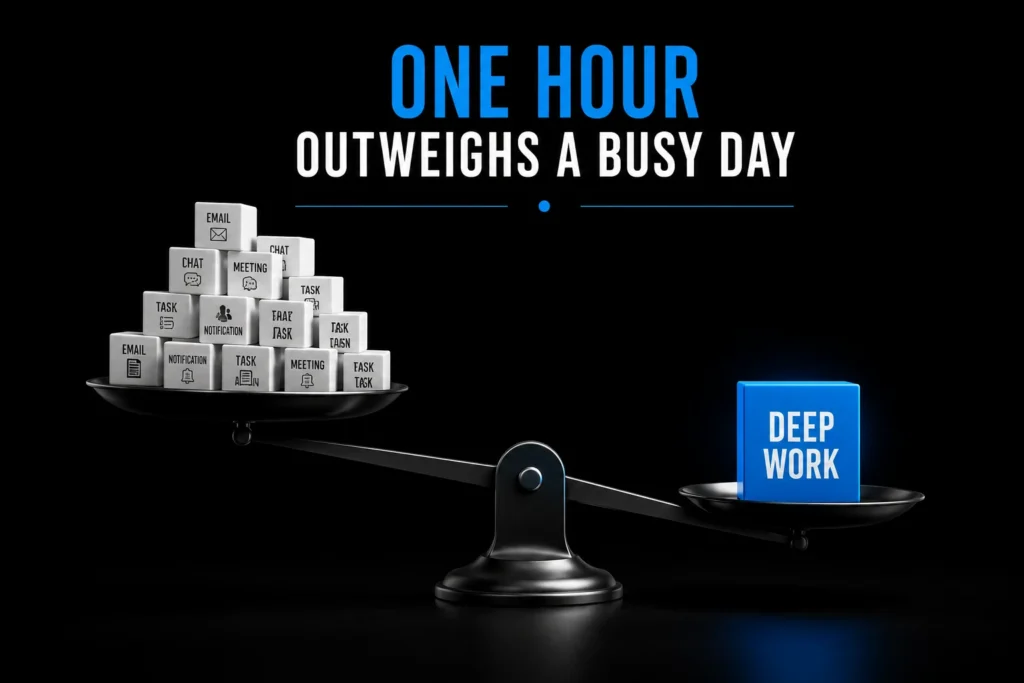
Shallow work doesn’t compound in the same way. A hundred answered emails produce no more than a hundred answered emails.
4. Why Most People Default to Shallow Work Every Day
If deep work is so valuable, why do most people spend so little time on it? The answer has three parts.
First: the environment defaults to shallow.
Every tool designed to make communication faster and easier — email, messaging apps, social media — is also a tool that fragments attention and pulls you toward shallow work. The default state of a connected device is interruption. Without active design to the contrary, the day fills with shallow work automatically.
Second: deep work is uncomfortable in a specific way.
When you sit down to do genuinely difficult, original work — and the page is blank, or the problem is unclear, or the thinking isn’t flowing yet — the discomfort is immediate and specific. The shallow work alternative is always available, always easier, and always provides the psychological relief of feeling productive without requiring the discomfort of real cognitive effort.
This is the mechanism behind most of what people call procrastination. It isn’t laziness. It is the rational preference for a lower-cost activity when the high-cost activity feels uncertain or difficult.
Third: shallow work is often socially rewarded.
Responding quickly is considered professional. Being available is considered reliable. Attending every meeting is considered collaborative. The behaviors of shallow work are visible and immediately valued — while the outputs of deep work are invisible in the short term.
The person who spends three hours in deep focus produces something significant. The person who spends three hours in meetings and emails produces a trail of visible activity. In many environments, the second person appears to be working harder.
→ Read: How to Build a Daily Routine for Mental Energy That Prevents Burnout Before It Starts
5. What Deep Work Produces That Shallow Work Never Can
The outputs of deep work are specific and irreplaceable.
Mastery. Skills that require genuine depth — writing well, thinking clearly, building complex things, solving non-obvious problems — are only developed through sustained concentrated effort. Shallow work doesn’t build mastery. It maintains existing levels.
Original thinking. The ideas worth having — the connections, the insights, the approaches that weren’t obvious — come from sustained immersion in a problem. Shallow work produces competent responses. Deep work produces original ones.
Work that lasts. An article written with full attention and genuine craft will be read, shared, and referenced long after it’s published. A paragraph written in fragments between notifications will read like it was produced that way. The quality of the attention you bring to work is present in the output — and readers can feel it even when they can’t name it.
Compounding value. Each piece of deep work builds on what came before in a way that shallow work cannot replicate. A body of writing, a developed skill, a reputation for original thinking — these are assembled from accumulated hours of focused effort. There is no shortcut that shallow work provides access to.
→ Read: How to Be More Productive Without Burning Out — What I Learned After Two Years of Doing It Wrong
6. How I Restructured My Days Around Deep Work
When I finally understood the deep work vs shallow work distinction clearly, I made one structural decision that changed my output more than anything else:
Deep work gets the first block of the day. Nothing else does.
Before email. Before messages. Before any reactive engagement with the world. The first 90 minutes of my working day belong entirely to the most important deep work task — identified the night before so there’s no decision cost in the morning.
The structure I settled on after 90 days of adjustment:
Morning Block — 6:00 to 7:30 AM: One task only. The most important deep work of the day. No phone, no email, no exceptions. The document is open before I sit down. The task is defined the night before.
Second Block — 8:00 to 9:30 AM: If the energy supports it — a second deep work session on the same or second most important task. By this point I’ve already produced more meaningful output than most full days used to generate.
Communication Window — 10:00 to 10:30 AM: This is the first time I open email or messages. Contained, time-limited, and positioned after the deep work is protected — not before.
Afternoon — Shallow Work Only: Scheduling, admin, routine decisions, anything that doesn’t require peak cognitive resources. By afternoon the deep work is done and the day can absorb whatever it needs to without cost.
The key insight: shallow work expands to fill whatever time you give it. If you don’t protect the deep work hours first, shallow work will take them. Every time.
→ Read: Time Tracking Productivity — What 30 Days of Honest Data Taught Me
7. The Mistakes I Made Trying to Do More Deep Work
I made three significant mistakes before the structure settled.
Mistake 1: Trying to do deep work in fragmented blocks.
Thirty minutes before a meeting. An hour between calls. Whatever time was left after the reactive work was done. Deep work doesn’t function well in short fragmented windows — not because you can’t think in short bursts, but because real depth requires a warm-up period before the thinking reaches its best level. A 90-minute block produces significantly more than three separate 30-minute blocks.
Mistake 2: Treating all tasks as equally deserving of deep work.
Not everything needs your best attention. I was spending deep work hours on tasks that were important but not cognitively demanding. Deep work is a limited resource. It should be reserved for tasks that genuinely require it and cannot be done well at lower attention levels.
Mistake 3: Expecting deep work to feel good immediately.
The first 15 to 20 minutes of a deep work session often feel uncomfortable. The thinking isn’t flowing, the page is resisting, the impulse to check something is strong. I used to interpret this as a sign that the session wasn’t working and switch to something easier.
It wasn’t a sign of failure. It was the warm-up. The quality of focus in minutes 20 to 90 is categorically different from the first 15. Learning to stay through the discomfort of the beginning is one of the most valuable skills in doing deep work consistently.
→ Read: The Real Reason You Quit Everything You Start — And the System That Finally Stopped It
8. How to Start Shifting the Balance This Week
You don’t need to restructure everything at once. One change, held consistently, will produce a visible difference within two weeks.
This week — one rule only:
Before you open email, messages, or any reactive platform tomorrow morning — do 60 minutes of your most important deep work task first. That’s it. Nothing else changes.
By the end of the week you’ll have experienced firsthand the difference between a morning that belongs to your most important work and a morning that belongs to everyone else’s priorities. That experience is more persuasive than anything written here.
Week two — add the shutdown ritual:
Each evening, write down tomorrow’s deep work task before you close your laptop. One specific task — not a list. This removes the decision from the morning when resistance is highest and ensures the deep work block starts immediately rather than spending its first 20 minutes figuring out what to do.
These two changes — protect the morning block, pre-decide the task — are the foundation. Everything else builds on them.
→ Read: How to Stay Consistent When You Don’t Feel Like It — The System That Actually Works
→ Read: Self Discipline: What I Was Actually Missing — And It Wasn’t Willpower
9. A Note From Victor
I want to be honest about what the deep work vs shallow work distinction cost me before I understood it.
For the first several months of building SmartXW, I was busy every day. Genuinely busy. I had a full schedule and very little to show for it at the end of most weeks. The articles that needed to be written weren’t getting written. The decisions that needed to be made were being deferred. The things that would have actually moved the site forward were consistently crowded out by things that felt urgent but weren’t important.
The shift wasn’t dramatic. I didn’t overhaul my life in a single decision. I made one change — protecting the first 90 minutes of my morning for the most important work — and within three weeks the output had measurably changed. Not because I was working harder. Because I was finally doing the work that compounded rather than the work that maintained.
If you’re working hard and wondering why the important things aren’t moving — the answer is probably not effort. It’s probably the ratio of deep to shallow work in your days. Change the ratio first. Everything else follows.
— Victor Kevin, SmartXW
10. Final Thoughts
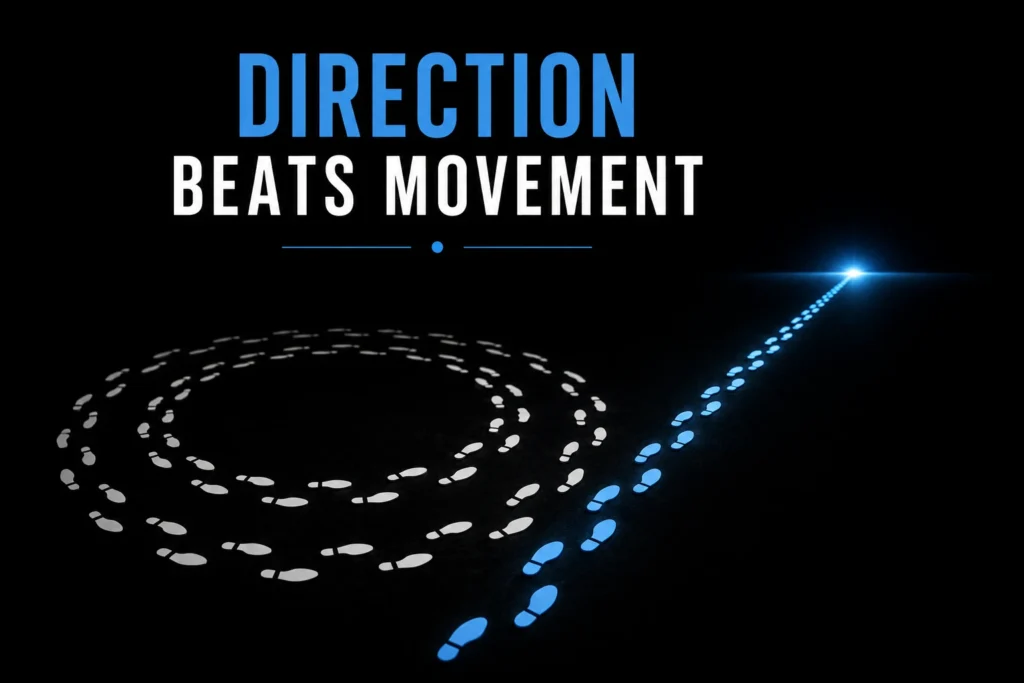
The deep work vs shallow work distinction is not a productivity hack. It is a fundamental question about how you spend the limited hours of focused attention available to you each day.
Shallow work is necessary. It keeps things running. But it doesn’t build anything on its own. The site, the skill, the body of work, the reputation — these are assembled from deep work and almost nothing else.
You don’t need more hours. You need more of the right hours — spent on the right work, protected from everything that would replace it with something easier.
One morning this week. One task. Ninety minutes of real focus before the shallow work begins.
That’s where the shift starts.
What is the one piece of deep work you’ve been postponing because the shallow work always gets there first? That’s where to begin.
→ Read: Discipline When Life Gets Hard: What I Do When Everything Falls Apart
→ Read: How to Make Better Decisions — The Framework I Use Before Every Important Choice
FAQ
What is the difference between deep work and shallow work? Deep work is cognitively demanding, distraction-free work that creates new value and requires your full focused attention — writing, strategic thinking, complex problem solving, skill development. Shallow work is the logistical, communicative, and administrative tasks that keep things running but don’t require deep thinking and don’t produce lasting output on their own. The practical difference: deep work builds things. Shallow work maintains them.
Why is deep work so hard to do? Because the environment defaults to shallow work, deep work is uncomfortable in its early stages, and shallow work provides immediate psychological rewards that deep work delays. Every notification, open tab, and available distraction is a lower-cost alternative that the brain naturally prefers over the sustained effort that deep work requires. Doing deep work consistently requires structural protection — not more willpower.
How many hours of deep work should I do per day? For most people working on cognitively demanding tasks, two to four hours of genuine deep work per day is realistic and significant. More is possible with practice, but the quality of the deep work matters more than the quantity. Two hours of genuine distraction-free focus produces more meaningful output than six hours of fragmented partial attention.
How do I start doing more deep work? Start with one protected block per day — 60 to 90 minutes, before reactive work begins, with the task pre-decided the night before. This single change consistently produces a measurable difference in output within two weeks. Add a second block once the first is stable. Build from there.
Is shallow work always bad? No. Shallow work is necessary — communication, administration, and coordination are real requirements of any meaningful work. The problem isn’t shallow work’s existence but its proportion. When shallow work expands to fill the entire day and crowds out the deep work entirely, nothing is built. The goal is the right ratio — not the elimination of shallow work.
Can deep work be done in short sessions? Short sessions are better than nothing, but deep work produces its best output in longer uninterrupted blocks. The first 15 to 20 minutes of any deep work session are typically a warm-up period where the thinking hasn’t reached its best level. A 90-minute block gives you 60 to 70 minutes of peak focus after the warm-up. Three separate 30-minute blocks give you almost none.
© 2026 SmartXW — Practical Growth, Mindset, Discipline Written by Victor Kevin