
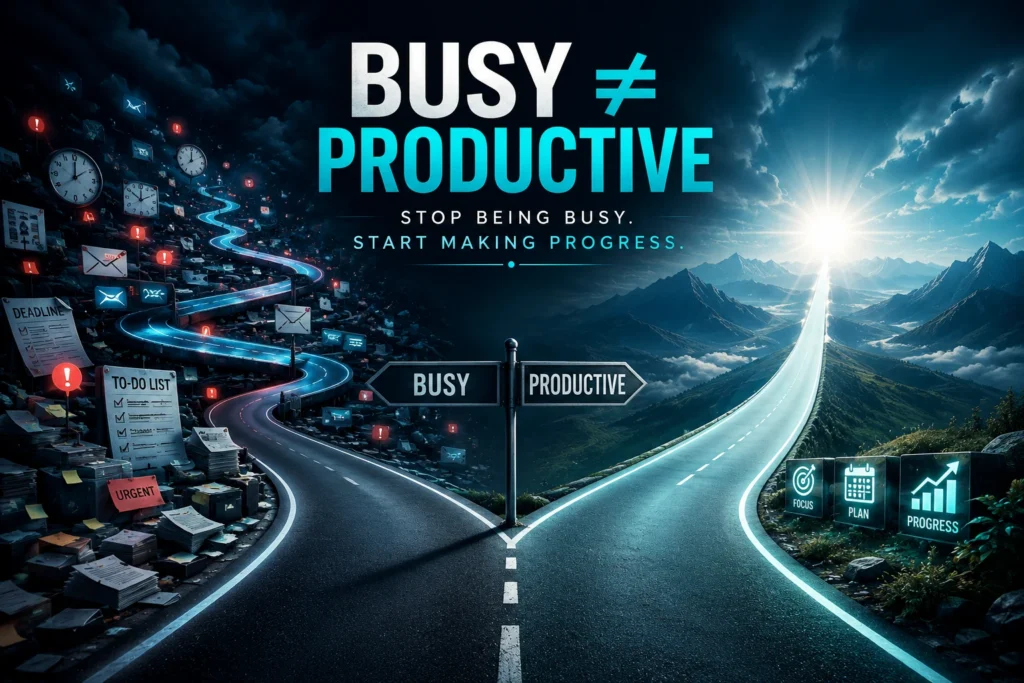
Most productivity advice doesn’t make you more productive. It makes you busier — which is the opposite of the same thing. Here’s what actually works, built from two years of getting it completely wrong first.
Table of Contents
- Two Years of Busy That Produced Almost Nothing
- The Productivity Myth Nobody Wants to Admit
- What Real Productivity Actually Looks Like
- Why Most People Burn Out Trying to Be More Productive
- The System That Finally Worked
- 5.1 The One Thing Rule
- 5.2 Energy-First Scheduling
- 5.3 The 90-Minute Deep Work Block
- 5.4 The Shutdown Ritual
- 5.5 The Weekly Reset
- The Productivity Habits Worth Keeping
- A Note From Victor
- How to Start This Week
- Final Thoughts
- FAQ
1. Two Years of Busy That Produced Almost Nothing
There was a version of me that woke up early, had a morning routine, tracked his tasks, used productivity apps, time-blocked his calendar, and read every piece of content he could find on working smarter.
That version of me was exhausted by noon and had almost nothing to show for it by evening.
I was doing everything the productivity world told me to do. I was implementing systems, optimizing routines, and filling every available hour with something that looked like work. On paper, I was the most disciplined version of myself I’d ever been.
In practice, I was running fast in circles.
The articles weren’t getting written. The ideas weren’t getting built. The things that actually mattered — the work that only I could do, the decisions that would actually move SmartXW forward — kept getting pushed to tomorrow because today was already full of everything else.
I had confused activity with output. I had confused busyness with progress. And I had built an entire daily architecture around looking productive rather than being productive.
That distinction — between looking productive and being productive — took me two years and a near-complete burnout to understand. This article is what I found on the other side of that.
2. The Productivity Myth Nobody Wants to Admit
The productivity industry is built on a comfortable lie: that the problem is always doing too little, and the solution is always doing more.
More systems. More optimization. More time reclaimed from inefficiency. More tools, more frameworks, more hacks that promise to squeeze another hour of output from every day.
This framing is wrong. And it’s wrong in a way that actively makes the problem worse.
The real productivity problem for most people isn’t that they’re doing too little. It’s that they’re doing too many of the wrong things — and adding more systems on top of that produces more structured busyness rather than more meaningful output.
The question that actually unlocks productivity isn’t how do I do more? It’s what is the one thing that, if I did it today, would make everything else easier or less necessary?
That question is uncomfortable because the answer is almost always the hardest thing on the list — the most important, most cognitively demanding, most emotionally risky piece of work. The kind that requires full presence and doesn’t respond well to being squeezed between meetings.
Most productivity systems never ask this question. They optimize the schedule without examining what’s being scheduled. They improve the efficiency of the machine without questioning whether the machine is pointed in the right direction.
I spent two years optimizing a machine that was pointing sideways. The efficiency improvements made no difference because the direction was wrong from the start.

3. What Real Productivity Actually Looks Like
Real productivity is deceptively quiet.
It doesn’t look like a full calendar or a long task list. It doesn’t look like responding to everything immediately or being available at all hours. It doesn’t look busy in the way that most people associate with hard work.
Real productivity looks like a morning where one important thing gets finished before anything else begins. It looks like an afternoon where the less important work gets handled efficiently because the cognitive resources weren’t depleted on low-value decisions before noon. It looks like an evening where you can close the laptop knowing the day’s most important work is done — not pending, not rescheduled, done.
The benchmark isn’t how many hours you worked. It’s whether the thing that matters most moved forward today.
That reframe changes everything about how you structure a day. It means protecting certain hours rather than filling them. It means saying no to things that don’t move the important work forward, even when they feel productive in the moment. It means designing your day around your output rather than your input.
The version of productivity that actually works is smaller, quieter, and more demanding than the version being sold. Smaller because it focuses on fewer things. Quieter because it doesn’t perform busyness. More demanding because it requires honest prioritization every single day rather than the comfort of a full schedule that lets you avoid the real work by staying permanently busy with everything else.
→ Read: What Is Decision Fatigue — And Why You Make Your Worst Choices After 3PM
4. Why Most People Burn Out Trying to Be More Productive
Burnout from productivity efforts has a specific mechanism that’s worth understanding clearly, because it’s not what most people think.
Most people assume burnout comes from working too hard. And sometimes it does. But the more common version — the one that catches people who are genuinely trying to build something — comes from a different source: the chronic gap between effort invested and meaningful output produced.
When you’re working hard and the important things still aren’t moving, the experience is deeply demoralizing in a way that ordinary tiredness isn’t. You’re not just exhausted. You’re exhausted and unconvinced that the exhaustion is producing anything worth producing.
That combination — high effort, low meaningful output, sustained over months — is what creates the specific kind of burnout that no amount of rest fully resolves. Because the problem isn’t the effort. The problem is the direction of the effort. And rest doesn’t fix direction.
There’s a second mechanism worth naming: decision fatigue masquerading as laziness. When your best cognitive resources are spent on low-stakes decisions throughout the morning — emails, small choices, reactive responses — the capacity available for genuinely important work degrades significantly by the time you turn to it.
The person who experiences this typically blames themselves for lack of discipline or focus. But the problem isn’t character. It’s sequencing. The right work in the wrong order produces the same result as no work at all.
I wrote about this directly in the context of how it affects discipline more broadly — the way the sequence of decisions through a day shapes what’s possible in the afternoon.
→ Read: How to Build a Daily Routine for Mental Energy That Prevents Burnout Before It Starts
5. The System That Finally Worked
This is not a productivity framework I read somewhere and applied. It’s what I built from two years of watching my previous systems fail — and understanding specifically why each one failed before building the next.
It has five components. Each one addresses a specific failure mode from the systems that didn’t work.
5.1 The One Thing Rule
Every day begins with one question before anything else opens: What is the single most important thing I can finish today?
Not the most urgent. Not the most visible. The most important — the piece of work that, if completed, would produce the most meaningful forward movement on the things that actually matter.
That thing gets scheduled first, before email, before messages, before any reactive work. It doesn’t share the first block of the day with anything else. It gets the best cognitive hours available — which are the first ones, before the day has had a chance to deplete them.
Everything else in the day is secondary to this. If the one thing gets done and nothing else does, the day was productive. If everything else gets done and the one thing doesn’t, the day was busy.
That distinction — productive versus busy — is the entire operating principle of this system.
5.2 Energy-First Scheduling
Most people schedule based on time. I schedule based on energy.
The distinction matters because cognitive capacity isn’t constant through the day. The quality of focused thought available at 7AM is categorically different from what’s available at 4PM — not because of motivation, but because of how the brain’s resources deplete through a day of decisions and engagement.
Knowing this, the schedule becomes a question of matching task type to energy level rather than filling available hours with whatever needs to be done.
Deep work — writing, strategy, complex problem-solving, anything requiring original thinking — gets the high-energy window in the morning. Collaborative work, calls, and creative discussions get the mid-morning to midday window when energy is still high but slightly less sharp. Administrative tasks, responses, and routine decisions get the afternoon when the resources for original thought are running low but execution is still reliable.
This sounds obvious. Almost nobody actually does it. Most people check email first thing in the morning — which means they spend their highest-quality cognitive hours on other people’s priorities rather than their own most important work.
5.3 The 90-Minute Deep Work Block
The deep work block is non-negotiable and non-interruptible.
Ninety minutes. One task. No notifications, no phone, no messages. The document is open before the session starts. The specific outcome for the session is defined the night before so there’s no decision cost at the start.
The 90-minute duration isn’t arbitrary. It aligns with the natural rhythm of focused attention — long enough to produce genuinely meaningful output, short enough to sustain the quality of focus throughout without degradation.
After 90 minutes, a full break — not checking messages during a walk, but an actual cognitive pause. Then, if the energy supports it, a second 90-minute block. Two blocks of real deep work in a morning produces more than most people generate in a full day of unfocused activity.
The resistance to this practice is almost always about urgency. Something always feels like it needs immediate attention. Learning to distinguish between things that feel urgent and things that are actually urgent is one of the most valuable productivity skills there is — and one of the hardest to build.
→ Read: The Real Reason You Quit Everything You Start — And the System That Finally Stopped It
5.4 The Shutdown Ritual
Every working day ends with the same three-step ritual. It takes five minutes and it changes the quality of the evening and the following morning significantly.
Step one: Review what was completed today against the one thing identified this morning. Did the important work happen? If not — why not, and what does tomorrow need to protect against the same outcome?
Step two: Identify tomorrow’s one thing. Not a list — one specific piece of work, written down, so that tomorrow morning begins with a decision already made rather than made in the moment when resistance is highest.
Step three: Close everything. Tabs, documents, applications. Not minimized — closed. This is the physical act that signals to the brain that the working day is complete. Without it, the mental state of the day persists into the evening, which reduces the quality of rest and the quality of the following morning.
The shutdown ritual is the part of this system most people skip — because ending the day deliberately feels less productive than continuing. It isn’t. The evening rest and the morning clarity it produces are part of the productivity system. They’re not separate from it.
5.5 The Weekly Reset
Once a week — I do it every Sunday evening — a fifteen-minute review of the week and a setup for the next one.
What moved forward this week? What didn’t, and why? What is the one most important thing the coming week needs to accomplish? What does the schedule need to look like to protect that?
This is the layer that prevents individual days from optimizing at the expense of the larger direction. It’s easy to have productive days that don’t add up to a productive week — because each day was optimized in isolation without reference to the bigger picture.
The weekly reset keeps the individual days pointed in the same direction. It catches drift before it compounds. And it gives the week a coherent shape rather than a collection of individually managed days.
6. The Productivity Habits Worth Keeping
Not everything from the productivity world is wrong. Some habits genuinely compound over time and deserve a permanent place in how you work.
Single-tasking over multitasking. Every time you switch between tasks, you pay a re-entry cost — the mental overhead of reorienting to the new context. Sustained focus on one thing, completed before moving to the next, is consistently more productive than dividing attention across multiple simultaneous tasks.
Batching similar work. Emails, calls, administrative tasks — grouped and handled together rather than scattered through the day. Each category of work has its own mental mode, and switching between modes costs more than staying in one.
The two-minute rule for small tasks. If something can be completed in under two minutes, do it immediately rather than adding it to a list. The mental overhead of tracking a small task is often larger than the task itself.
Preparing tomorrow the night before. Knowing what tomorrow’s most important work is before you go to sleep removes the decision from the morning — when the temptation to choose something easier is highest.
Protecting the first hour. The first sixty minutes of the working day set the cognitive tone for everything that follows. What you do with that hour — whether you give it to reactive input or to your most important work — determines more about your productivity than any other single decision.
→ Read: How to Stay Consistent When You Don’t Feel Like It — The System That Actually Works
→ Read: Discipline When Life Gets Hard: What I Do When Everything Falls Apart
7. A Note From Victor
I want to be honest about what the two years of failed productivity actually cost.
It wasn’t just the time. It was the confidence erosion that comes from working hard and seeing almost nothing move. There’s a particular kind of discouragement that comes from sustained high effort with low meaningful output — it’s different from being lazy, and it’s harder to fix, because you can’t simply try harder when you’re already trying hard.
What I eventually understood is that productivity is not a character trait and not a discipline problem. It’s a design problem. The days that worked weren’t the ones where I had more willpower — they were the ones where I had built the conditions for important work to happen before anything else arrived to compete with it.
If you’re working hard and still feeling like you’re standing still — you’re probably not lazy and not undisciplined. You’re probably designing your days around the wrong things. The fix isn’t more effort. It’s better architecture.
That’s the only thing two years of getting it wrong actually taught me. And it was worth learning.
— Victor Kevin, SmartXW
8. How to Start This Week
Not everything. One thing.
Today: Identify your one most important task before you open anything else tomorrow morning. Write it down tonight.
Tomorrow: Do that task first. Before email, before messages, before anything reactive. Give it 90 minutes of uninterrupted focus. Then handle everything else.
This week: Run this experiment for five days. At the end of the week, look at what actually moved forward compared to a normal week.
The result will tell you more than this article can. The experience of a morning where the important work gets done before the day has a chance to fill itself with everything else is more persuasive than any argument. The goal of this week is to produce that experience once — and let it make the case for itself.
9. Final Thoughts
Learning how to be more productive is not about doing more. It is about doing the right things in the right order with the conditions those things actually require.

The system in this article is not complicated. One most important task per day. Energy-first scheduling. A protected deep work block. A shutdown ritual. A weekly reset. Each piece addresses a specific failure mode. Together they produce a day that reliably moves the most important work forward without the unsustainable cost that most productivity advice quietly demands.
You don’t need to optimize every hour. You need to protect the right ones.
What is the one most important thing you’ve been putting off that this week could actually finish? Start there.
→ Read: The Comfort Zone Trap: Why Staying Safe Is the Riskiest Thing You Can Do
→ Read: How to Build Discipline: What 90 Days Taught Me That No Book Ever Did
FAQ
How do I become more productive every day? Start by identifying one most important task each day before anything else begins — and completing it before reactive work starts. This single shift, applied consistently, produces more meaningful output than any system built on optimizing a long task list. Productivity is not about the number of tasks completed. It is about whether the work that matters most moved forward.
Why am I not productive even when I try hard? Because effort and direction are different things. High effort applied to the wrong tasks produces exhaustion without meaningful progress. The first question to ask isn’t how to work harder — it’s whether the work you’re doing is actually the most important work available to you right now. If the answer is no, the solution is reprioritization, not more effort.
What is the best productivity system? The best system is the one that consistently gets your most important work done before the day fills with everything else. The specific tools and frameworks matter less than the underlying principle: protect high-energy hours for high-importance work, batch low-value tasks, and end each day knowing what tomorrow’s most important work will be before it begins.
How do I stop being busy and start being productive? By replacing the question “what do I need to do today?” with “what is the one thing that, if done today, would make everything else easier or less necessary?” Busyness is what happens when all tasks are treated as equally important. Productivity is what happens when they aren’t.
How long does it take to build productive habits? Individual habits typically stabilize in 30 to 60 days of consistent practice. A complete restructuring of how you work — scheduling, priorities, energy management, daily rituals — takes longer, usually 60 to 90 days before it stops requiring active maintenance and starts running on its own momentum.
Can I be productive without burning out? Yes — but only if the productivity system is built around energy management rather than time management. Burnout from productivity typically comes from high effort with low meaningful output sustained over time, or from treating all hours as equally available for demanding work. A system that matches task type to energy level and protects genuine recovery prevents the depletion that leads to burnout.
© 2026 SmartXW — Practical Growth, Mindset, Discipline Written by Victor Kevin
Read me.
Great blog.