
Table of Contents
- You’ve Been Solving the Wrong Problem
- The Real Reason You Quit — It’s Not What You Think
- The Quit Cycle: How It Works and Why It Repeats
- Six Patterns That Guarantee You’ll Stop Before You Finish
- The System That Finally Broke the Cycle for Me
- 5.1 The Minimum Viable Commitment
- 5.2 The Identity Anchor
- 5.3 The Recovery Protocol
- What Happened When I Applied This Over 60 Days
- How to Start the System This Week
- Final Thoughts
- FAQ
Introduction
I’ve quit more things than I’ve finished.
That’s not easy to write, but it’s true — and I think it’s true for most people who are honest with themselves. I’ve started morning routines that lasted four days. Fitness habits that lasted two weeks. Writing schedules that held for a month and then quietly dissolved. Projects I was genuinely excited about that somehow never got past the early stage.
For a long time I told myself the same story: that I wasn’t disciplined enough, that I lacked the willpower other people seemed to have, that there was something in my character that made sustained commitment difficult. I believed this for years. It made everything worse.
The story was wrong.
What I eventually understood — after enough failed starts to finally look at the pattern rather than the individual failures — is that quitting isn’t a character trait. It’s a structural problem. And structural problems don’t respond to motivation or self-criticism. They respond to systems.
I wrote recently about building a daily routine for mental energy — how structure protects your cognitive resources and prevents the depletion that leads to poor decisions. This article goes one layer deeper. Because the routine I described only became possible once I solved a prior problem: why I quit every system I’d ever tried to build before I got to the point where it could help me.
This is what I found.
1. You’ve Been Solving the Wrong Problem
Every piece of advice about consistency assumes the problem is motivation. Get more excited. Find your why. Visualize the outcome. Connect to your purpose.
This advice isn’t useless. But it targets the wrong mechanism.
Motivation is a feeling. Feelings are temporary. Building a sustained behavior on a feeling is the same as building a structure on a foundation that changes with the weather. It holds when conditions are right and collapses when they aren’t — which is precisely when you need it most.
The problem isn’t that you don’t care enough. The problem is that your system isn’t designed to survive the days when caring isn’t enough.
Every person who has ever quit something they genuinely wanted was, on at least some of those days, still motivated. They still wanted the outcome. But wanting the outcome and having a structure that functions regardless of how you feel on a given Tuesday are completely different things.
When I stopped asking “how do I stay motivated?” and started asking “how do I build something that works even when I don’t feel like it?” — everything changed. Not immediately, and not without failure. But the direction of change reversed.
2. The Real Reason You Quit — It’s Not What You Think
Here is what actually happens when people quit things, based on my own patterns and years of paying close attention to how this cycle works.
It’s almost never a single dramatic decision to stop. There’s rarely a moment where you consciously choose to give up. What happens instead is quieter and more gradual: a small inconsistency goes unaddressed, which makes the next inconsistency easier, which makes the next one easier still, until the behavior simply stops existing without you ever formally deciding to end it.
You missed one morning. You told yourself you’d make it up tomorrow. Tomorrow came and the moment wasn’t right. You told yourself you’d restart Monday. Monday arrived with new complications. By the following week, the habit was gone — not because you quit, but because you never quite restarted.
This is the mechanism. And the reason it repeats is that most systems have no protocol for the miss. They assume continuous execution. When continuity breaks — and it always eventually breaks, because life is not continuous — there’s no instruction for what to do next. So the brain defaults to the path of least resistance: stop.
The system that finally worked for me was the first one I built around the inevitable miss, not the assumed continuity.
3. The Quit Cycle: How It Works and Why It Repeats
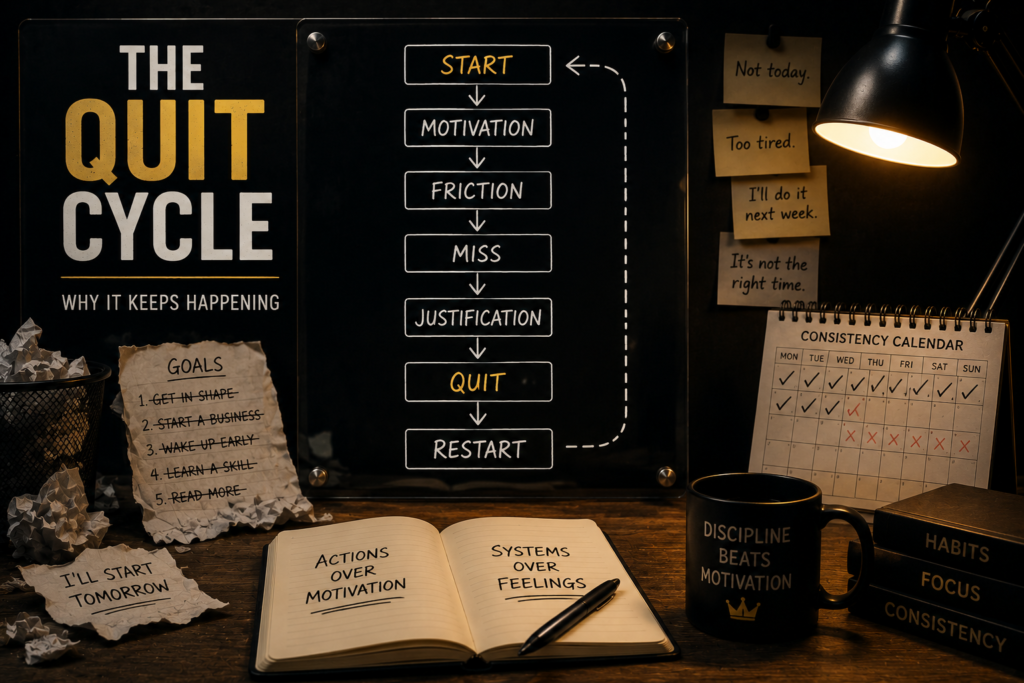
Understanding this cycle was the turning point. Once I could see it clearly, I could interrupt it.
Stage 1 — The Launch. You start with genuine energy. The new habit, goal, or system feels meaningful and achievable. This energy is real but it has a half-life. It will not last at this intensity, which is not a problem unless your system depends on it.
Stage 2 — The First Friction. Something disrupts the pattern. A difficult day, an unexpected commitment, an illness, a shift in circumstances. This is not extraordinary — it’s ordinary. It happens to everyone. The system’s survival depends entirely on what happens next.
Stage 3 — The Justification. You explain the miss to yourself in a way that feels reasonable. The circumstances were genuinely unusual. You’ll compensate. It’s a temporary exception. This is the most dangerous stage — not because the justification is always wrong, but because it delays the recovery that needs to happen immediately.
Stage 4 — The Widening Gap. Each day without return makes the return feel larger. The gap between where you are and where the habit requires you to be grows. What was one missed day becomes three. Three becomes a week. The psychological cost of returning increases with the gap, which makes return less likely, which widens the gap further.
Stage 5 — The Quit Narrative. At some point, the mind needs to resolve the cognitive dissonance between “I want this” and “I’m not doing this.” The resolution it reaches is almost always about character rather than structure: I’m not the kind of person who does this. I’m not disciplined enough. I always quit.
This narrative then becomes the lens for the next attempt — which it sabotages before it begins.
The cycle doesn’t repeat because you’re weak. It repeats because nothing in the system interrupted it.
→ Read: Discipline When Life Gets Hard: What I Do When Everything Falls Apart
4. Six Patterns That Guarantee You’ll Stop Before You Finish
These are the specific patterns I watched in myself — the ones that reliably predicted a quit before it happened.
Pattern 1: Starting too big. The version you commit to on day one is the version you’d run at peak motivation. It’s not the version you can run on a Wednesday when work ran long and you’re tired. The gap between those two versions is where most habits die. Starting smaller than feels necessary is not weakness — it’s the only approach that survives contact with a real week.
Pattern 2: All-or-nothing execution. If the standard is perfection, any deviation is failure. And failure, framed that way, justifies stopping. The person who does 80% of their habit every day for a year produces vastly more than the person who does 100% for three weeks and quits. Consistency at a lower intensity beats intensity without consistency every time.
Pattern 3: No defined recovery protocol. What do you do when you miss? If the answer is “try harder tomorrow,” that’s not a protocol — that’s wishful thinking. A real protocol is specific: if I miss one day, I do a reduced version the next day. If I miss two days, I restart at the minimum version for one week before returning to full. The protocol removes the decision about what to do after a miss, which is the exact moment when decision fatigue is highest and quitting is easiest.
Pattern 4: Tying the habit to motivation. “I’ll do it when I feel like it” ensures you’ll only do it when conditions are already good. Conditions are rarely consistently good. Habits tied to time and environment rather than feeling are incomparably more stable. Every morning at 6AM before I open anything else is a different instruction than when I feel ready.
Pattern 5: No identity connection. Behaviors that exist purely as tasks are fragile. Behaviors that connect to who you believe yourself to be are substantially more resilient. The difference between “I’m trying to write every day” and “I’m a writer” is not semantic — it changes how you recover from misses and how you respond to friction.
Pattern 6: Measuring results instead of actions. Results take time and don’t arrive linearly. Measuring results early — asking “is this working?” before the compounding has had time to show — leads to premature quitting based on incomplete evidence. Measuring the action instead removes this problem entirely. Did I do the thing today? Yes or no. That’s the only question that matters in the first 90 days.
5. The System That Finally Broke the Cycle for Me
This is not a framework I read somewhere and applied. It’s what I built from the wreckage of enough failed attempts to understand what was actually needed.
It has three components. All three are necessary. Any two without the third will eventually fail.
5.1 The Minimum Viable Commitment
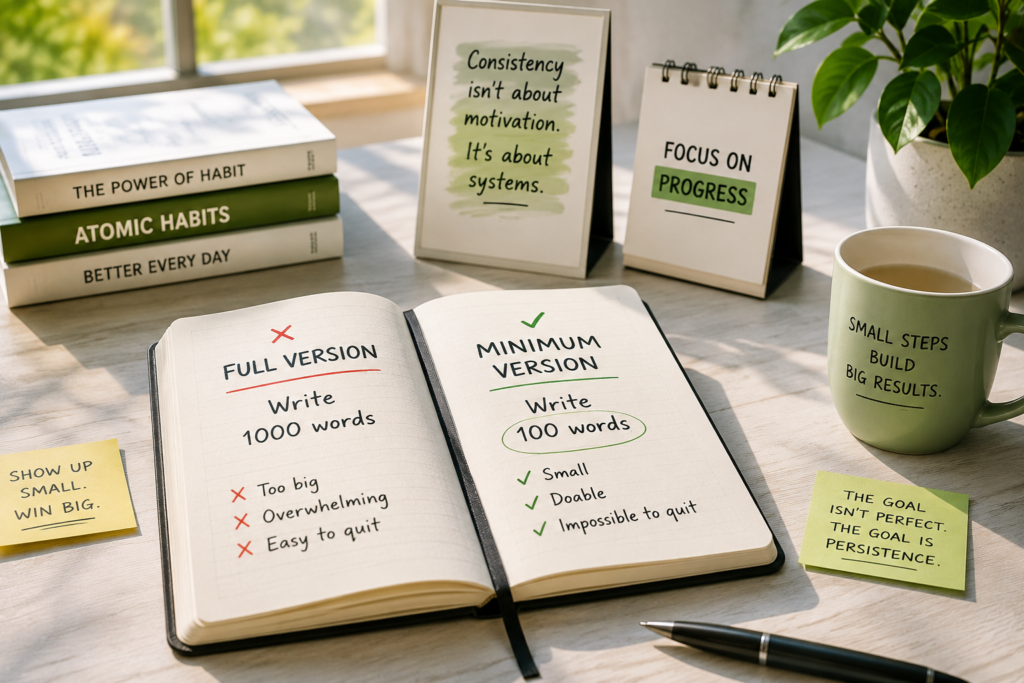
Every habit I maintain now has two versions: the full version and the minimum version.
The full version is what I do on a normal day. The minimum version is what I do when everything is difficult — when I’m tired, when life is complicated, when the last thing I want is to show up for this thing I committed to.
The minimum version is designed to be almost embarrassingly small. For writing, it’s one paragraph. For movement, it’s ten minutes. For the morning routine I described in my daily routine for mental energy article, the minimum version is fifteen minutes of the most essential elements only.
The purpose of the minimum version is not to produce results. It is to maintain the identity and the streak on the days when the full version is genuinely impossible. A one-paragraph writing session does almost nothing for the work. It does everything for the self-concept of being someone who writes every day.
That self-concept is the real asset. Protect it above everything else.
5.2 The Identity Anchor
Every system I now commit to is attached explicitly to an identity statement — not an outcome statement.
The difference matters enormously in practice. “I want to be consistent” is an outcome. “I am someone who shows up every day regardless of how I feel” is an identity. Outcomes are achieved and then what? Identities are ongoing. They don’t have an endpoint that, once reached, removes the reason to continue.
When I miss a day now — and I still miss days — my recovery question isn’t “how do I get back on track?” It’s “what would the person I’m becoming do right now?” That reframe is not motivational language. It’s a practical decision-making tool that bypasses the emotional friction of return and replaces it with a simpler question.
The identity anchor also changes how you narrate the miss to yourself. Instead of “I failed again” — which feeds the quit narrative — it becomes “that wasn’t like me, and tomorrow I’ll show up.” One of these stories makes return more likely. The other makes it less.
5.3 The Recovery Protocol
This is the piece most systems don’t include and the reason most systems fail.
My recovery protocol is written down. It exists before I need it, so I don’t have to decide what to do after a miss at the exact moment when my decision-making capacity is lowest.
It works like this:
One missed day — run the minimum version the next day. No self-criticism, no compensation, no attempt to make up the deficit. Just the minimum version, done.
Two to three missed days — return at the minimum version for the full following week before resuming the standard version. The temptation after a longer gap is to return at full intensity to compensate. This almost always fails because the gap has made the return psychologically large. The minimum version makes the door small enough to walk through.
More than a week — restart the habit from day one of the original onboarding process. Not as punishment. Because a week-long gap means the habit is no longer automatic, and treating it as though it is leads to the overcommitment that caused the gap in the first place.
The recovery protocol exists for one reason: to make return the path of least resistance. Every system that makes quitting easier than returning will be quit. Every system that makes return straightforward will be returned to.
→ Read: Self Discipline: What I Was Actually Missing — And It Wasn’t Willpower
6. What Happened When I Applied This Over 60 Days
I want to be precise about results because vague claims about transformation aren’t useful.
At the end of 60 days applying this system, I had maintained four habits without a single full quit — the first time in my life I could say that. There were misses. Several of them. But the recovery protocol meant every miss was followed within 24 to 48 hours by a return. The streak, measured not as unbroken perfect execution but as consistent return, held.
The most significant change was cognitive rather than behavioral. The quit narrative — the internal voice that said you always stop, this is who you are — lost its authority. Not because I proved it wrong through perfect execution. Because I proved it wrong by returning every time I fell short. Returning after a miss is more powerful evidence against the quit narrative than never missing in the first place, because it demonstrates that the pattern isn’t inevitable.
The habits I maintained over those 60 days were not dramatic. But the proof they generated — that I could build something that survived contact with a real, imperfect life — changed what I believed was possible for me. And that belief is worth more than any single habit.
7. How to Start the System This Week
Day 1 — Choose one habit only. Not three. Not a routine. One behavior that matters and that you’ve quit before. Write it down with a specific time and trigger: At 6AM, before I open my phone, I will write for 20 minutes.
Day 1 also — Define the minimum version. What does this habit look like on your worst possible day? Write that down too. It should take less than five minutes and require almost no activation energy. This is not your goal. It is your floor.
Day 1 also — Write the recovery protocol. What will you do if you miss one day? Two days? A week? Write the answers before you need them. Put them somewhere you’ll see them when the miss happens.
Week 1 — Track only the action, not the result. Did you do the thing today? Yes or no. That is the only metric that matters this week. Do not evaluate whether it’s working. It’s too early to know. Evaluation before 30 days is almost always misleading.
Week 2 — Add the identity statement. Write one sentence that describes the person you are becoming through this habit. Read it every morning before you begin. Not as motivation — as orientation.
By the end of two weeks you’ll have the architecture of a system that can survive what no motivation-based approach can: an ordinary difficult week in a real life.
→ Read: How to Start Over: What Nobody Tells You About Rebuilding Yourself From Zero

8. Final Thoughts
You don’t quit because you’re weak. You quit because your system assumed you’d always be strong — and no system that requires ideal conditions can survive real ones.
The three-part system in this article isn’t about becoming someone who never fails. It’s about becoming someone who always returns. That distinction changes everything — because returning, done consistently, produces the same compounding result as never failing, and it’s actually achievable.
Start with one habit. Build the floor before you build the ceiling. Write the recovery protocol before you need it.
Everything else is detail.
What’s the one thing you’ve quit more than twice that you still genuinely want? That’s where to start.
→ Read: The Comfort Zone Trap: Why Staying Safe Is the Riskiest Thing You Can Do
→ Read: What Is Decision Fatigue — And Why You Make Your Worst Choices After 3PM
FAQ
Why do I keep quitting things I actually want to do? Because the system you’re using was built for ideal conditions and your life isn’t ideal. Quitting isn’t a character flaw — it’s what happens when a system has no protocol for the inevitable miss. The solution isn’t more motivation. It’s a structure designed to survive imperfect execution.
What is a minimum viable commitment? A minimum viable commitment is the smallest version of a habit that still counts as doing it. Its purpose isn’t to produce results — it’s to maintain your identity as someone who shows up, even on the worst days. One paragraph, ten minutes, one set. Small enough that no legitimate excuse can prevent it.
How do I stop the all-or-nothing thinking that makes me quit? By redefining success. Success is not perfect execution — it’s consistent return. Someone who does 80% of their habit every day for a year and returns after every miss outperforms someone who does 100% for three weeks and quits. Build a recovery protocol and measure return rate, not streak length.
How long does it take to build a habit that actually sticks? The honest answer is that it varies, but 60 to 90 days of consistent return — not perfect execution, but consistent return — is typically when a behavior shifts from effortful to default. The first 30 days are the most fragile. Having a recovery protocol in place before day one determines whether you make it through them.
What’s the difference between quitting and a strategic pause? Intent and protocol. A strategic pause is planned, time-limited, and followed by a defined return. Quitting is unplanned, open-ended, and followed by a quit narrative that makes the next attempt harder. The distinction isn’t always obvious in the moment — which is why a written recovery protocol matters. If you have one, what you’re doing is pausing. If you don’t, you’re probably quitting.
Can this system work for big goals, not just daily habits? Yes — with adaptation. For large goals, the minimum viable commitment becomes a minimum viable action: the smallest possible forward movement you can make on a difficult day. The identity anchor and recovery protocol apply identically. The scale changes. The structure doesn’t.
© 2026 SmartXW — Practical Growth, Mindset, Discipline Written by Victor Kevin