
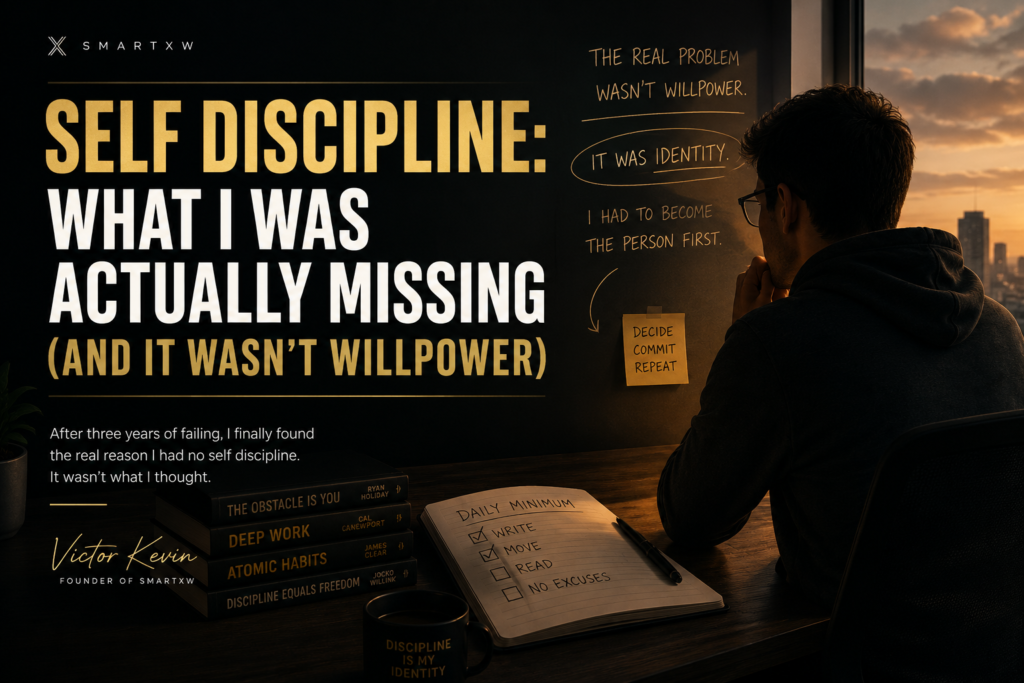
Self discipline was the one thing I kept failing at — and for three years, I thought I knew why.
I told myself I lacked willpower. That I wasn’t wired for consistency. That some people just had the thing I was missing, and I would figure out how to borrow it from them eventually — through the right book, the right system, the right moment of clarity.
None of that was true. And believing it kept me stuck for longer than I want to admit.
What I actually lacked wasn’t willpower. It wasn’t motivation, or the right routine, or the right environment. It was something quieter and more specific — a misunderstanding so fundamental that no system could have fixed it, because I was solving the wrong problem entirely.
This is the piece I wish I had read in 2022. Not because it’s clever, but because it’s honest about something most self-discipline advice skips.
Table of Contents
- What Three Years of Failing Looked Like
- The Diagnosis I Kept Getting Wrong
- The Identity Problem Nobody Names Directly
- What Changed in Late 2024
- The Three Root Causes of Broken Self Discipline
- What Self Discipline Actually Requires
- Frequently Asked Questions
What Three Years of Failing Looked Like
I want to be precise about the timeline, because vague confessions aren’t useful.
From roughly mid-2022 to late 2024, I attempted to build consistent self discipline three times. Each attempt followed the same arc: a strong start, two to three weeks of genuine momentum, a disruption of some kind, and then a slow drift back to the default. By the time I admitted the attempt had failed, I was usually back where I started — except with a new layer of evidence that I wasn’t the kind of person who could follow through.
The three attempts weren’t identical. Each one failed for a slightly different reason on the surface. But looking back now, they all failed for exactly the same reason underneath. I just couldn’t see it at the time.
What I could see was the pattern. Start strong. Hold for a few weeks. Break the chain once. Tell myself I’d recover. Don’t recover. Stop entirely. Wait until the discomfort of having stopped became stronger than the discomfort of starting again. Repeat.
Victor’s Note: I kept a notebook during this period. Reading it now, what strikes me most isn’t the failures — it’s how confidently wrong I was about the cause. Each time I failed, I diagnosed a different problem and designed a new solution for it. Better schedule. Clearer goals. More accountability. None of it addressed what was actually happening.
The Diagnosis I Kept Getting Wrong
Every time my self discipline collapsed, I ran the same diagnostic: what did I do wrong?
And every time, I found something. The schedule was too rigid. The goal was too vague. I hadn’t told anyone, so there was no accountability. I had told too many people, so there was too much pressure. I was trying to change too many things at once. I wasn’t trying hard enough. The timing was off.
Each diagnosis was plausible. Each solution was reasonable. And each new attempt, built on a corrected version of the previous mistake, failed in the same fundamental way.
It took me an embarrassingly long time to consider a different question. Not what did I do wrong — but what did I misunderstand about how self discipline actually works?
The answer, when I finally found it, was this: I had been treating self discipline as something you apply to your behavior. It isn’t. It’s something that emerges from your identity.
This sounds like a motivational poster. Stay with me — it’s more specific than it sounds.
The Identity Problem Nobody Names Directly
Every time I tried to build self discipline, I approached it from the outside in. I would design a system — a schedule, a set of rules, a method for tracking and accountability — and then attempt to force my behavior to match the system.
This works in the short term. The first two weeks of any new system are fueled by novelty and intention, and they usually produce genuine results. The problem isn’t the first two weeks.
The problem is week three or four, when the system requires something that doesn’t feel like you. When the habit asks you to show up and some part of you quietly asks: is this actually who I am?
If the answer isn’t clear — if you haven’t genuinely decided that the disciplined version of the behavior is part of your identity, not just your schedule — the system will crack at exactly that moment. Every time.
What I was doing in all three failed attempts was essentially borrowing an identity and hoping it would become mine through repetition. It doesn’t work that way. The identity has to come first, or at least alongside the behavior — not as a destination you arrive at after enough reps.
The specific question I was never asking myself, in any of those three years, was this: do I actually see myself as someone who does this?
Not: do I want to be that person. Not: do I admire that person. Not: do I have a plan to become that person.
Do I, right now, see myself as someone who does this?
For most of that period, the honest answer was no. And no system in the world can sustain behavior that the person running it doesn’t believe belongs to them.
What Changed in Late 2024
The shift didn’t come from a new book or a better framework. It came from a single conversation with myself that I’d been avoiding.
In September 2024, about a month before I launched SmartXW, I sat down and wrote out the most uncomfortable question I could think of: Who do I actually believe I am when it comes to consistency and follow-through?
Not who I wanted to be. Not who I was trying to become. Who did I actually, genuinely believe I was — based on the evidence of my own behavior over the past three years?
The answer was painful and clarifying: I believed, on some level, that I was someone who starts things and doesn’t finish them. Not because I had decided that. Because I had shown it to myself, repeatedly, and absorbed it as a fact.
That belief was running in the background of every attempt I’d made. Every time I started a new system, some part of me was waiting for the moment I’d quit — because I always had. The system wasn’t fighting my laziness. It was fighting my self-image. And self-image wins almost every time.
The thing I changed wasn’t the system. I changed the answer to the question.
I decided — not hoped, not planned, but decided — that I was going to be someone who writes every day. Not because I had earned that identity yet, but because I was going to act from it starting immediately, and the evidence would accumulate behind the decision.
Victor’s Note: This sounds simple stated directly. It wasn’t simple in practice. The decision had to be made again, quietly, on most mornings for the first two months. Not dramatically — just a recognition, each time the resistance appeared: this is who I am now, not who I’m trying to become. The distinction is small. The difference in behavior is not.
The Three Root Causes of Broken Self Discipline
Looking back across those three years and forward through what’s changed since, I can see three root causes that apply not just to my experience but to almost every pattern of failed self discipline I’ve observed.
1. Identity misalignment
As described above: the behavior doesn’t match who you believe you are. The gap between the action and the self-image is too wide, and the self-image wins by default.
The fix isn’t to force the behavior longer until the identity catches up. The fix is to deliberately update the identity first — to make a real decision about who you are, not just who you want to be — and let the behavior follow from that.
2. Borrowed standards
For most of those three years, the habits I was trying to build weren’t mine. They were assembled from other people’s systems, other people’s routines, other people’s ideas of what a disciplined person looks like.
Borrowed standards are fragile. When the system feels effortful — and it always will, eventually — you have nothing underneath to sustain it. You’re holding up someone else’s structure with your own energy, and you don’t fully believe in the structure because it was never really yours.
The discipline that finally stuck for me was built around writing — something I actually wanted to do, for reasons that were genuinely mine. Not because writing is inherently easier than other habits. Because it was attached to a real reason I couldn’t borrow from anyone else.
3. Treating the symptom instead of the pattern
Every time I failed and diagnosed the failure, I found a real problem. The diagnosis was usually accurate. The solution usually addressed it. And the next attempt still failed.
Because the visible failure — missed a day, broke the chain, lost momentum — was always a symptom. The root cause was always one of the two things above: an identity that didn’t match the behavior, or a standard that was never mine to begin with.
Fixing the symptom without addressing the root makes for more sophisticated failures, not fewer.
What Self Discipline Actually Requires
After three years of getting it wrong and eighteen-plus months of getting it progressively more right, here is what I believe self discipline actually requires — in order of importance:
First: a genuine decision about identity. Not a goal. Not a plan. A decision about who you are. This decision has to be real — which means it has to be made from honesty, not aspiration. If you don’t believe it when you make it, it won’t hold under pressure.
Second: a reason that’s actually yours. The habit has to be attached to something you genuinely care about, for reasons you can articulate without referencing anyone else’s framework. If you can only explain why you’re doing something in borrowed language, the reason probably isn’t deep enough to sustain the hard days.
Third: a realistic picture of the hard days. Self discipline doesn’t mean every day is productive and focused and on track. It means you have a plan for the days it isn’t — a minimum that keeps the identity intact even when everything else fails. I’ve written about this elsewhere. The minimum isn’t the goal; it’s the floor that protects the goal on bad days.
Fourth: patience with the gap. There will be a period — weeks, sometimes months — where the identity you’ve decided on and the behavior you’re producing don’t fully match. The behavior will sometimes be weak, the sessions bad, the output unimpressive. That period is not evidence that the approach is wrong. It’s the normal gap between a decision and its accumulation of proof.
Self discipline is not a character trait you either have or you don’t. It’s a practice that requires, more than anything else, getting honest about what you actually believe about yourself — and being willing to change that belief before you’ve earned the right to.
Frequently Asked Questions About Self Discipline
What is self discipline, really? Self discipline is the ability to act on a decision you’ve already made — regardless of how you feel in the moment. It’s not a personality trait or a fixed character quality. It’s a practice built on identity: when you genuinely see yourself as someone who does the thing, the behavior becomes far easier to sustain than any system or schedule can make it.
Why do I have no self discipline even when I really want to change? Usually because wanting to change and deciding who you are aren’t the same thing. Most people approach self discipline by designing better systems — schedules, habits, accountability. Those help, but they can’t override a self-image that says “I’m not someone who follows through.” The root cause is almost always identity, not effort.
How long does it take to build self discipline? There’s no fixed number — but the honest answer is longer than most articles suggest and shorter than most people fear. The early phase, where every session requires a conscious decision, typically lasts four to eight weeks. After that, the behavior becomes more automatic — not effortless, but less contested. What matters more than duration is consistency: even one session per day, done badly, compounds faster than perfect sessions done inconsistently.
Can self discipline be learned, or are some people just born with it? It can be learned. The research is clear on this, and my own experience confirms it. What looks like natural self discipline in other people is almost always the result of accumulated small decisions made over time — most of which happened privately and weren’t visible to anyone watching. Nobody is born disciplined. They practice it until it becomes part of who they are.
What’s the difference between self discipline and willpower? Willpower is a resource — it depletes during the day and recovers with rest. Self discipline is a structure — it reduces the need for willpower by making the decision in advance. Relying on willpower to stay disciplined is like relying on motivation: it works sometimes, fails unpredictably, and exhausts you in the process. The goal of building self discipline is to need less willpower, not to develop more of it.
What should I do when my self discipline breaks down? Return to the minimum as fast as possible — without ceremony, without a new plan, without treating the break as meaningful. The speed of recovery matters more than the perfection of the streak. One missed day followed by an immediate return does almost no damage. One missed day followed by a week of guilt and planning does significant damage. Break the chain, come back tomorrow, keep going.
This article is about the root cause — the why underneath the struggle. If you’re ready to look at the how, start with How to Build Discipline: What 90 Days Taught Me and Why You Can’t Start.
Victor Kevin has been writing about discipline, mindset, and self-improvement at SmartXW since October 2024 — from real experiments, not theory.