
I made one of the worst decisions of my life on a Tuesday afternoon.
Not because I lacked information. Not because I hadn’t thought it through. I made it because I was exhausted, frustrated, and in exactly the kind of mental state where doing something felt better than doing nothing — even when that something was wrong.
It cost me six months.
That experience changed everything about how I approach how to make better decisions — not as a thinking exercise, but as a structural problem. The quality of a decision has almost nothing to do with intelligence and everything to do with the conditions under which you make it. Get the conditions wrong and even your best thinking produces your worst choices.
Most people never examine those conditions. They focus on the decision itself — the options, the pros and cons, the potential outcomes — while ignoring the state they’re in when they decide. That’s where the real errors happen. Not in the analysis. In the timing.
This article is the framework I built after learning that the hard way. Five steps I now run before every decision that matters — designed to protect the choice from the conditions that would make it worse before it’s even made.
Table of Contents
- The Decision That Cost Me Six Months
- Why Most People Make Bad Decisions — It’s Not What You Think
- The Three Enemies of Good Decision Making
- The Framework I Use Before Every Important Choice
- 4.1 The Timing Check
- 4.2 The Clarity Question
- 4.3 The Reversal Test
- 4.4 The 10-10-10 Rule
- 4.5 The Commitment Line
- Decisions You Should Never Make in the Moment
- How to Build a Personal Decision Making System
- A Note From Victor
- How to Start Using This Framework Today
- Final Thoughts
- FAQ
1. The Decision That Cost Me Six Months
There was a point in building SmartXW where I made a significant decision about the direction of the site after a particularly difficult week.
I was tired. I had been dealing with a problem that had been draining my energy for days. I was frustrated with the pace of progress, uncertain about whether the approach was working, and in exactly the frame of mind where doing something — anything — felt better than continuing in the same direction.
So I decided to change course. I restructured the content strategy, reconsidered the niche focus, and spent the following weeks implementing a direction that felt decisive and energizing in the moment.
Six months later, I was back where I’d started — with the original approach, which had been right all along. The detour had cost me time, momentum, and a significant amount of the confidence that comes from staying committed to something long enough to see it work.
The decision itself wasn’t wrong because I lacked information. It was wrong because I made it in the worst possible conditions — depleted, reactive, and looking for relief rather than clarity.
That experience was the beginning of what eventually became the framework in this article. Not a decision making theory, but a practical set of checks I now run before any decision that matters — designed specifically to prevent me from making important choices in the conditions that make bad choices almost inevitable.
2. Why Most People Make Bad Decisions — It’s Not What You Think
The conventional story about bad decisions is that they come from insufficient information or faulty reasoning. If you’d only known more, thought harder, researched longer — you would have chosen better.
This is sometimes true. But it’s not the most common cause of poor decision making in everyday life. The most common cause is far more mundane:
Most bad decisions are made at the wrong time, in the wrong state, under the wrong conditions.
The person who decides to quit something valuable after a particularly hard day isn’t making a rational assessment of whether to continue. They’re making an emotional response to accumulated exhaustion. The person who commits to something new in a moment of high enthusiasm isn’t making a considered choice about long-term fit. They’re responding to the feeling of possibility before the reality of implementation has had a chance to register.
Neither of these is a thinking failure. Both are timing failures.
I wrote about this in my article on decision fatigue after 3PM — how the quality of judgment deteriorates through the day not because of stupidity but because of a resource that depletes with use. The implications for decision making are significant: the same decision, made in two different states, can produce two genuinely different choices — and only one of them reflects your actual values and judgment.
Understanding this changes what you do about bad decisions. It shifts the focus from “how do I think better?” to “how do I create the conditions in which my thinking is actually reliable?”
That shift is the foundation of the framework.
3. The Three Enemies of Good Decision Making
Before the framework itself, it’s worth naming the three conditions that most reliably produce poor decisions — because recognizing them is the first step in avoiding them.
Enemy 1: Depletion.
When cognitive resources are low — from a long day of smaller decisions, from physical fatigue, from emotional stress — the brain defaults to shortcuts. It favors the familiar over the considered. It optimizes for immediate relief rather than long-term fit. It gravitates toward whichever option requires the least additional thinking, regardless of whether that option is actually best.
Depleted decision making is the most common source of choices people regret. Not because they were thinking poorly — but because they were thinking with less than they had available earlier in the day.
Enemy 2: Emotional reactivity.
Decisions made in the peak of strong emotion — whether positive or negative — are almost always less reliable than decisions made in a calmer state. Not because emotions are irrelevant to decisions. They’re not — they carry important information about values and preferences. But peak emotional states distort the weight given to immediate feelings relative to longer-term considerations.
The decision made in anger, in grief, in excitement, or in fear is rarely the decision you’d make with the same information and a quieter nervous system. Waiting for emotional intensity to settle before deciding isn’t weakness. It’s one of the highest-value practices in decision making.
Enemy 3: Time pressure that isn’t real.
Most important decisions that feel urgent aren’t. The feeling of urgency is real — but the actual deadline is usually more flexible than it appears in the moment. The brain under perceived time pressure narrows its focus, reduces the options it considers, and defaults to action over reflection.
Learning to distinguish between genuine urgency and the feeling of urgency is one of the most useful decision making skills available. Almost every decision that genuinely requires an immediate response is obvious. The ones that require real judgment almost always have more time than they appear to.
4. The Framework I Use Before Every Important Choice
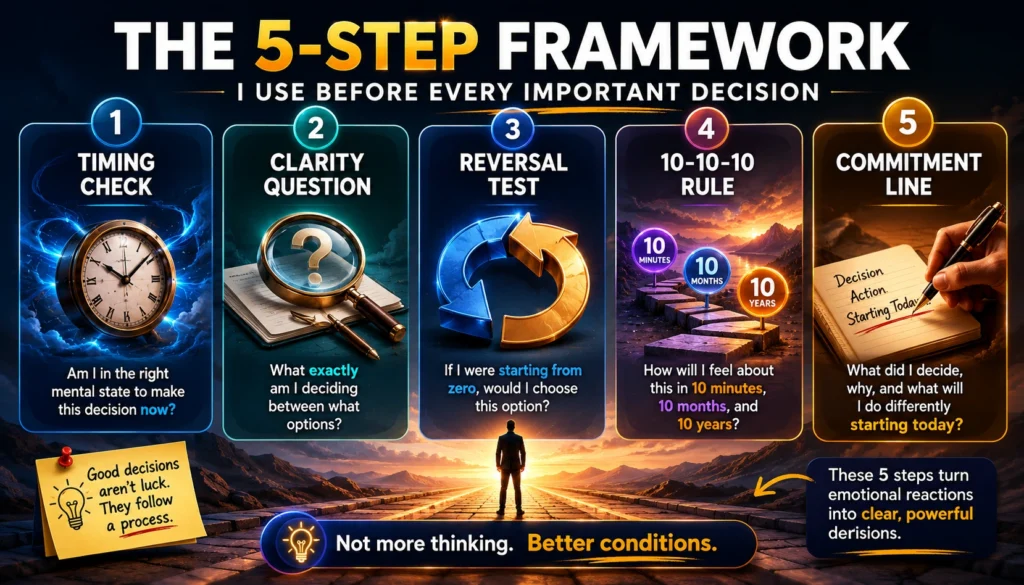
This framework is not a formula that produces right answers. It is a set of conditions and questions that I’ve found reliably separate good decisions from reactive ones — and that have saved me, more than once, from choices I would have immediately regretted.
I run through these five steps before any decision that is significant, irreversible, or that I notice I’m feeling urgency about.
4.1 The Timing Check
Before anything else — before I consider the options or weigh the factors — I ask one question:
Am I in a good state to make this decision right now?
Not “am I smart enough” or “do I have enough information.” Am I rested, calm, and in the kind of mental state where my judgment is actually reliable?
If the answer is no — if I’m tired, emotionally activated, or in the afternoon window where I know my cognitive resources are running low — the decision doesn’t get made. Not because I’m avoiding it, but because I’m protecting it from the conditions that would make it worse.
This single check has prevented more bad decisions than any other element of the framework. Most important decisions can wait 24 hours. The ones that can’t are usually not as consequential as they feel.
→ Read: How to Build a Daily Routine for Mental Energy That Prevents Burnout Before It Starts
4.2 The Clarity Question
Once the timing is right, I ask: What am I actually deciding?
This sounds obvious. It almost never is. Most decisions that feel difficult are difficult because they haven’t been clearly defined — the actual choice is obscured by adjacent concerns, emotional weight, or conflation with other decisions that aren’t actually part of this one.
Writing the decision in one specific sentence forces that clarity. Not “I need to figure out what to do about X” — but “I am deciding whether to do A or B by [date], based on [criteria].”
The act of writing this sentence frequently reveals that what felt like a complicated decision is actually a straightforward one — or that what felt like one decision is actually three separate decisions that need to be made in sequence.
Clarity about what you’re deciding reduces the cognitive load of deciding it. And reduced cognitive load produces better quality thinking.
4.3 The Reversal Test
For every significant decision, I ask: If I were in this situation but hadn’t yet made any decision, would I choose this option?
This test is designed to catch one of the most common decision making errors: the status quo bias — the tendency to maintain existing choices not because they’re best, but because changing them feels riskier than staying put.
The reversal test removes the asymmetry. It puts the existing situation and the potential change on equal footing and asks which you’d choose if you were starting fresh. If the answer is “I’d choose what I already have” — that’s a genuine endorsement of the status quo. If the answer is “I’d choose something different” — the status quo is probably being maintained by inertia rather than quality.
This works in both directions. It also catches the opposite error — the impulse to change because change feels active and staying feels passive. When applied to a potential new direction, it asks: if you were already doing this new thing, would you want to switch to where you are now? If yes, the change is probably not as good as it feels.
4.4 The 10-10-10 Rule
Before committing to any significant decision, I ask three questions:
How will I feel about this in 10 minutes? How will I feel about this in 10 months? How will I feel about this in 10 years?
The purpose isn’t to get precise predictions. It’s to force the decision out of the immediate emotional frame and into a wider temporal perspective.
Decisions that look obviously right in 10 minutes but questionable in 10 months are usually reactive. Decisions that feel uncomfortable in 10 minutes but clearly right in 10 months are usually the ones worth making despite the discomfort. Decisions that look the same at all three timeframes are the most reliable.
This rule is most useful for decisions involving discomfort — where the short-term cost of a choice is clear and the long-term benefit is abstract. It gives the abstract future a voice in the room alongside the immediate present.
→ Read: The Comfort Zone Trap: Why Staying Safe Is the Riskiest Thing You Can Do
4.5 The Commitment Line
The last step is the one most people skip — and it’s the one that converts a decision into an actual change.
Once I’ve run through the previous four steps and arrived at a choice, I write it down with three things: what I decided, why I decided it, and what I will do differently as a result starting today.
The “starting today” part is non-negotiable. A decision without an immediate action attached to it remains a thought rather than a commitment. The gap between deciding and acting is where most decisions quietly dissolve — overridden by the next mood, the next urgent thing, or the next moment of doubt.
Writing the immediate action closes that gap. It converts the decision from an internal event into an external commitment — and external commitments are dramatically more durable than internal ones.
5. Decisions You Should Never Make in the Moment
Some categories of decision are almost always better deferred — not because they’re complex, but because the conditions under which they typically arise are reliably poor.
Never decide to quit something important after a single bad day. One hard day is not representative data. The question of whether to continue something significant deserves to be answered by your average experience, not your worst one.
Never make a significant financial or professional commitment in the peak of enthusiasm. Enthusiasm is real information about potential interest — but it systematically overestimates future motivation and underestimates future friction. Wait 48 hours. If the enthusiasm survives, it’s more likely genuine.
Never respond to an emotionally charged message immediately. Write the response if you need to — but don’t send it. Responses written in the peak of reaction almost always need editing when the emotional intensity settles. The editing is always better done before sending rather than after.
Never restructure something that’s working because you’re bored with it. Boredom with a functioning system is one of the most expensive impulses in building anything. The feeling that something needs to change is often about your emotional state, not the quality of the system.
→ Read: What Is Decision Fatigue — And Why You Make Your Worst Choices After 3PM
→ Read: How to Stop Overthinking and Take Action — The Method That Actually Works
6. How to Build a Personal Decision Making System

The framework above works best when it becomes a habit rather than a deliberate process — when the questions run automatically rather than requiring active recall.
Building that habit takes deliberate practice over time. Here’s how to start:
Keep a decision log. For one month, write down every significant decision you make, the conditions under which you made it, and the outcome. Patterns emerge quickly. You’ll likely find that a specific time of day, emotional state, or type of pressure is responsible for a disproportionate number of poor choices.
Create a default deferral rule. For any decision that doesn’t require an immediate response, apply a standard waiting period — 24 hours for moderate decisions, 48 to 72 hours for significant ones. This removes the need to evaluate urgency case by case and prevents reactive decisions by default.
Review past decisions regularly. Once a month, look back at significant decisions from the previous four weeks. What conditions produced them? Which ones are you glad you made? Which ones do you wish you’d approached differently? This review generates the self-knowledge that the framework is designed to apply.
→ Read: How to Build Discipline: What 90 Days Taught Me That No Book Ever Did
→ Read: Why You Quit Everything You Start — And the System That Finally Stopped It
7. A Note From Victor
The six-month detour I described at the beginning of this article wasn’t a tragedy. I want to be honest about that.
It was expensive in time and momentum. But it also taught me something about decision making that no framework could have taught me in theory: the difference between a decision made from clarity and a decision made from depletion is not subtle. You can feel it in retrospect with remarkable precision.
The decision to change course felt decisive at the time. It had the emotional texture of resolve — of finally doing something instead of waiting. What I understand now is that decisiveness and good judgment are not the same thing. You can act decisively from a bad state and produce a worse outcome than doing nothing would have.
The framework in this article exists because of that experience — not as a way to avoid making wrong decisions entirely, because that’s not possible. As a way to make sure that when I’m wrong, I’m wrong for reasons I couldn’t have known rather than reasons I could have prevented.
That distinction is the most useful thing I’ve learned about how to make better decisions. Not how to be right more often. How to make sure the errors are honest ones.
— Victor Kevin, SmartXW
8. How to Start Using This Framework Today
Pick one decision you’ve been avoiding or one you’ve been feeling pressure to make quickly.
Step one: Run the timing check. Are you in a good state to decide this right now? If not — schedule it for tomorrow morning before anything else begins.
Step two: Write the decision in one specific sentence. What exactly are you deciding, between what options, by when?
Step three: Apply the reversal test. If you were starting fresh with no existing commitment, which option would you choose?
Step four: Run the 10-10-10. How does each option look at 10 minutes, 10 months, 10 years?
Step five: Write the commitment line. What did you decide, why, and what do you do differently starting today?
The first time takes twenty minutes. After enough repetitions, it takes five. And the quality of the decisions it produces — measured against the alternatives made without it — will make the investment obvious.
9. Final Thoughts
Learning how to make better decisions isn’t about becoming more analytical or gathering more information before you act. It’s about building the conditions in which your existing judgment — which is more reliable than you probably think — can actually function at its best.
The framework in this article is not complicated. Check the timing. Clarify what you’re actually deciding. Test for status quo bias. Consider multiple time horizons. Commit with an immediate action.
Five steps. Twenty minutes. The difference between a decision you own and one you regret.
What is one decision you’ve been putting off that this framework could clarify today? Start there.
FAQ
How do I make better decisions in everyday life? Start by protecting the conditions under which you decide. Most poor everyday decisions are made when energy is low, emotions are elevated, or time pressure feels higher than it actually is. A default rule of deferring non-urgent decisions by 24 hours removes the majority of reactive choices before they happen — without requiring any additional thinking in the moment.
What is a good decision making framework? A good framework addresses the conditions of the decision before the content of it. The five-step framework in this article does exactly that: timing check, clarity question, reversal test, 10-10-10 rule, and commitment line. Together they filter out reactive decisions and ensure that the choices that get made reflect considered judgment rather than momentary state.
Why do I make bad decisions even when I think carefully? Because careful thinking in a depleted or emotionally activated state is less reliable than it feels. The experience of thinking hard doesn’t guarantee the quality of the output — it depends heavily on the cognitive resources available when the thinking happens. Timing and state matter more than effort.
How do I stop making impulsive decisions? By creating structural friction between the impulse and the action. A default waiting period — 24 hours for moderate decisions, 48 to 72 for significant ones — converts most impulsive choices into considered ones without requiring willpower in the moment. The impulse that survives 24 hours of reflection is far more likely to be a genuine preference than one acted on immediately.
What is the best time of day to make important decisions? Morning — specifically before decision fatigue from the day’s smaller choices has accumulated. The first one to two hours of the working day, before reactive work begins, represents peak cognitive quality for most people. Scheduling significant decisions for this window and protecting it from lower-stakes inputs produces measurably better outcomes than deciding whenever the need arises.
How do I make decisions without overthinking? By separating the decision process from the decision moment. Run the framework in a dedicated session rather than in the moment the decision presents itself. This contains the thinking to a defined period rather than letting it spread across hours or days — and it produces a clear output rather than the circular exhaustion that overthinking typically generates.
© 2026 SmartXW — Practical Growth, Mindset, Discipline Written by Victor Kevin