
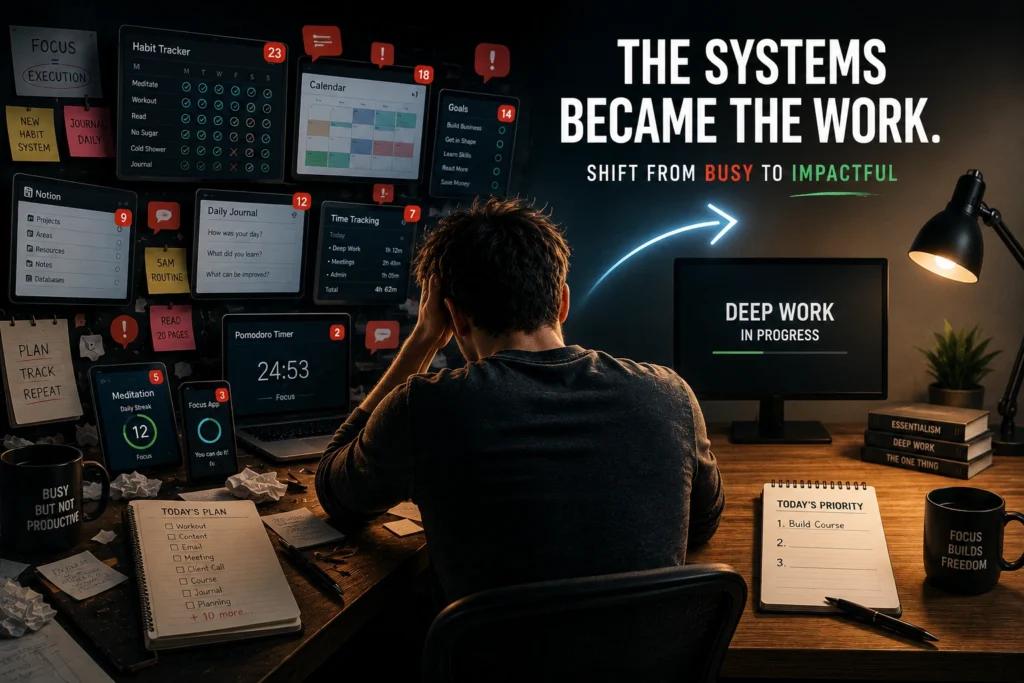
Is self improvement toxic, or does it just feel that way once it takes over your whole day? That’s the question I kept circling back to last year, when my calendar had color blocks for everything — a tracker for habits, a tracker for time, a journal for reflection, a framework for decisions, a system for energy management. Six different tools, each one genuinely useful on its own. Together, they were costing me more time to manage than the actual work I was supposed to be doing.
That was about eight months ago — roughly a year and a half after I launched SmartXW. By then I’d already written about discipline, about consistency, about building habits that stick. I assumed I’d done the hard part. What I hadn’t accounted for was what happens when every piece of advice you’ve ever applied is running at the same time.
That’s when I started asking a question I hadn’t let myself ask before: is self-improvement toxic, or had I just built something too complicated to survive contact with an ordinary day? This article is the honest comparison between the two paths — stacking every system I could find, versus stripping back to almost nothing — and what each one actually did to my output.
Table of Contents
- Systems vs Simplicity: The Core Difference Nobody Explains
- Why Stacking Systems Feels Productive While It’s Failing You
- What Simplicity Actually Looked Like Once I Tried It
- Systems vs Simplicity: Side-by-Side Comparison
- 5 Practical Ways to Tell If You’re Overloaded
- Key Takeaways
- Final Thoughts
- Frequently Asked Questions
1. Systems vs Simplicity: The Core Difference Nobody Explains
A system is a structure you build to make a behavior automatic. Simplicity is the discipline of only keeping the structures that earn their place. Both are useful. The mistake I made was treating “more systems” as the same thing as “more growth.”
Here’s the part most self-improvement content skips: a system has a maintenance cost. Every tracker you check, every framework you reference, every routine you have to remember takes a small amount of attention before it gives anything back. One system, that cost is invisible. Six systems running at once, the cost becomes the job.
👉 I first ran into a lighter version of this while building my morning routine: How to Build a Daily Routine for Mental Energy
2. Why Stacking Systems Feels Productive While It’s Failing You
Adding a new system always feels like progress in the moment. You read something useful, you build a structure around it, and for the first few days it works — because novelty does most of the heavy lifting early on.
The problem shows up later, when the fifth or sixth system is competing with the first for the same ten minutes of morning attention. I’d open my habit tracker and feel behind on three other systems before I’d done a single piece of real work. The tools meant to create order were generating their own kind of noise.
Nobody warns you about this because each individual system, reviewed on its own, looks completely reasonable. It’s the stack that’s the problem, not any single piece of it.
👉 This is the same blind spot I wrote about in: Decision Fatigue and Why You Make Your Worst Choices After 3PM
3. What Simplicity Actually Looked Like Once I Tried It

I cut it down to one system: a single list, reviewed once a day, with no more than three priorities on it. Everything else — the trackers, the secondary journals, the energy frameworks — got archived, not deleted, just set aside.
In practice, the simplified version had three rules, and that was it: one priority list, three important tasks for the day, one short review before I closed my laptop. No app to open, no streak to protect, no second list to cross-check against the first. If something didn’t fit on three lines, it didn’t make the cut that day.
The first morning, I sat down without my usual five-tab ritual and genuinely didn’t know what to do with my hands. I’d open my laptop and reach, out of habit, for a tracker that wasn’t there anymore. That reflex told me something I hadn’t wanted to admit: a lot of what I’d built wasn’t really about getting better. It was about having something to check.
By day three, the discomfort started turning into something else. I noticed I was starting work faster — no ten minutes of reviewing yesterday’s numbers before I let myself begin. I noticed I was finishing tasks instead of half-finishing them and moving on to update a different system about the half-finished one. The work itself, which had quietly become the smallest part of my day, started taking up the most space again.
By the end of the first week, I went looking for the old systems — not to bring them all back, but to see which ones I’d actually missed. Most of them, I hadn’t thought about once. The energy framework, the secondary journal, two of the three trackers — gone, and I hadn’t noticed their absence in any way that mattered. One piece did come back: a short evening note, three or four lines, about what actually happened that day. I missed that one specifically, not because a routine told me to do it, but because I kept thinking about things I wanted to write down. That difference — wanting something back versus dutifully reinstalling it — turned out to be the entire test.
What surprised me most wasn’t the productivity gain, though that was real. It was how much quieter my own head felt. I hadn’t realized how much background noise six overlapping systems generate until it stopped. Decisions that used to route through three different frameworks now just got made. A morning that used to start with fifteen minutes of administrative throat-clearing now started with the first real task of the day.
None of this means simplicity is automatically superior or that everyone should be running one list. What it showed me is that complexity has to keep earning its keep, and most of mine had stopped earning anything months earlier — it was just still there, out of habit, dressed up as discipline.
This isn’t just a personal quirk. Most people who try to run several systems at once hit the same wall eventually — not because the systems are flawed, but because attention is a limited resource and every extra system quietly taxes it.
👉 This lines up with something I learned the hard way in: How to Stay Consistent When You Don’t Feel Like It
4. Systems vs Simplicity: Side-by-Side Comparison
| Stacking Systems | Simplicity | |
|---|---|---|
| Primary cost | Attention spent maintaining tools | Almost none |
| Best for | Exploring new methods, early experimentation | Sustained daily output |
| Failure mode | Tool fatigue, decision overload | Can miss nuance on complex goals |
| Mental load | High — constant tracking and cross-checking | Low — one clear priority list |
| Sustainability | Tends to collapse under a busy week | Survives disruption better |
| Best used when | You’re testing what actually works for you | You already know what works and need to execute |
Neither column is “correct” on its own. Stacking systems is genuinely useful early on, when you’re figuring out what actually fits your life. Simplicity is what makes the system you’ve already validated sustainable for years instead of weeks.
5. 5 Practical Ways to Tell If You’re Overloaded
1. Count your check-ins, not your goals Add up how many trackers, apps, or routines you personally have to look at in a normal day. More than three or four is usually a sign the structure is competing with the work.
2. Notice if you feel behind before you’ve started If opening your systems in the morning makes you feel like you’re already catching up, that’s the maintenance cost showing itself.
3. Ask which system you’d keep if you could only pick one If the answer comes instantly, the rest are probably optional. If you can’t choose, that’s worth sitting with honestly.
4. Track how often you update the system versus do the work A quick honest count for a few days usually reveals whether your systems serve the work or have become the work.
5. Try removing one system for a week and see what you miss Whatever comes back on its own, because you actually wanted it, is probably worth keeping. Whatever you don’t miss tells you everything.
👉 I used a version of this audit when I wrote: What I Learned From Tracking Every Hour of My Day for 30 Days
6. Key Takeaways
- Self-improvement isn’t toxic — accumulating systems without ever subtracting any is what turns it into a burden.
- Every system has a maintenance cost; past three or four running at once, that cost competes directly with the actual work.
- Novelty makes a new system feel productive immediately; the real test is whether it still earns its place after the novelty fades.
- Simplicity isn’t the opposite of growth — it’s often what makes growth sustainable past the first few weeks.
- The fastest way to find out which systems matter is to remove one and see what you genuinely miss.
7. Final Thoughts
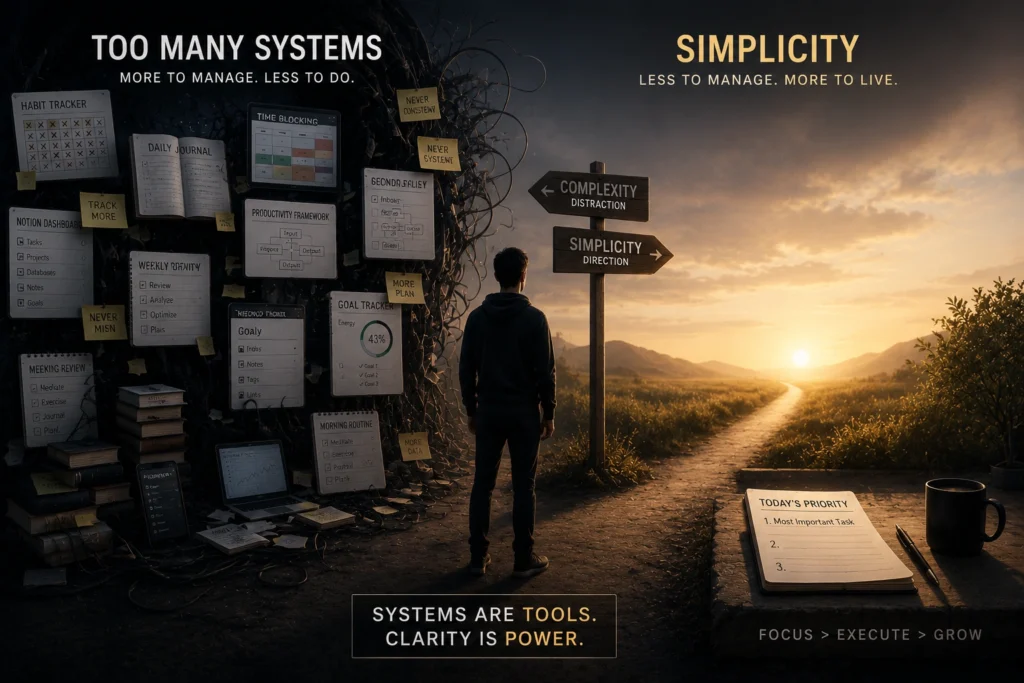
Self-improvement isn’t toxic. Treating every new method as something to add, with nothing ever subtracted, is what turns it into a burden. The goal was never to collect the most systems — it was to find the fewest ones that actually move your life forward, and trust them enough to stop adding more.
I still believe in almost everything I’ve written on this site — the routines, the discipline, the consistency. None of that changed. What changed is that I stopped treating “more structure” as automatically better, and started asking whether each piece was still earning the attention it cost me.
If your routines have started competing with each other for the same hour of your morning, that’s not a sign you need a better system. It’s a sign you have enough systems already, and what’s missing is the discipline to stop adding new ones.
— Victor Kevin, Founder of SmartXW
8. Frequently Asked Questions
Q: Is self-improvement actually toxic? Not inherently — but an unlimited, never-subtracted accumulation of methods can become a burden that works against the goals it was meant to support. The content isn’t the problem; the absence of a stopping point is.
Q: How many systems or habits is too many? There’s no fixed number, but if checking and maintaining your systems takes noticeably more attention than the actual work each day, that’s a practical signal to simplify.
Q: Should I get rid of all my systems and habits? No — the comparison isn’t “systems are bad,” it’s about matching the number of systems to what you can actually sustain. Removing some temporarily helps you see which ones earn their place.
Q: How do I know which system to keep when I have too many? Keep the one you’d choose instantly if you could only have one. The systems you hesitate over are usually the ones adding more cost than value.
Q: Is wanting a simpler routine a sign of giving up on growth? No. Choosing fewer, sustainable systems is often what allows growth to continue long-term, instead of collapsing under its own complexity.
Q: Is this connected to what you’ve written about discipline and consistency? Yes — simplicity is what makes discipline and consistency sustainable. A single system you can maintain for a year beats six systems you abandon within a month.