

Prevent burnout before it starts — and stop losing your best hours to exhaustion you never saw coming. This is my complete personal daily schedule, built and tested over 90 days.
Table of Contents
- Why Mental Fatigue Happens Even When You Feel “Rested”
- Early Warning Signs Your Mental Energy Is Running Low
- 7 Common Daily Routine Mistakes That Accelerate Mental Fatigue
- The Complete Daily Routine That Protects Your Mental Energy
- 4.1 Morning Block
- 4.2 Midday Block
- 4.3 Afternoon Block
- 4.4 Evening Wind-Down
- How I Built and Tested This Routine Over 90 Days
- How to Start This Routine in the Next 14 Days
- Final Thoughts
- FAQ
Introduction
There was a period — about eight months into building SmartXW — when I was doing everything right on paper and falling apart in practice.
I was sleeping enough. I wasn’t skipping meals. I wasn’t pulling all-nighters. By every external measure, I was rested. And yet by early afternoon I was useless. Not tired in the way that a nap fixes. Tired in the way where a simple decision felt like lifting something heavy, where a paragraph that should have taken twenty minutes took two hours, where everything I sat down to do required twice the effort it deserved.
I spent months thinking it was a motivation problem. Then I thought it was a sleep quality problem. Then I thought I simply wasn’t cut out for sustained, high-output work.
It was none of those things.
What I was experiencing was mental fatigue — the quiet depletion of cognitive energy that happens not from doing too much, but from doing things in the wrong order, at the wrong times, without the structural protection that prevents the tank from draining in the first place. I’d written about what happens when that fatigue hits in the afternoon in my article on decision fatigue after 3PM — but this article goes one step earlier. This is about building a daily routine for mental energy that stops the depletion before it starts.
What follows is the complete routine I built, tested, and now live by. It isn’t perfect. It took ninety days of adjustment to get right. But it works — and I’ll show you exactly how to build your own version starting this week.
1. Why Mental Fatigue Happens Even When You Feel “Rested”
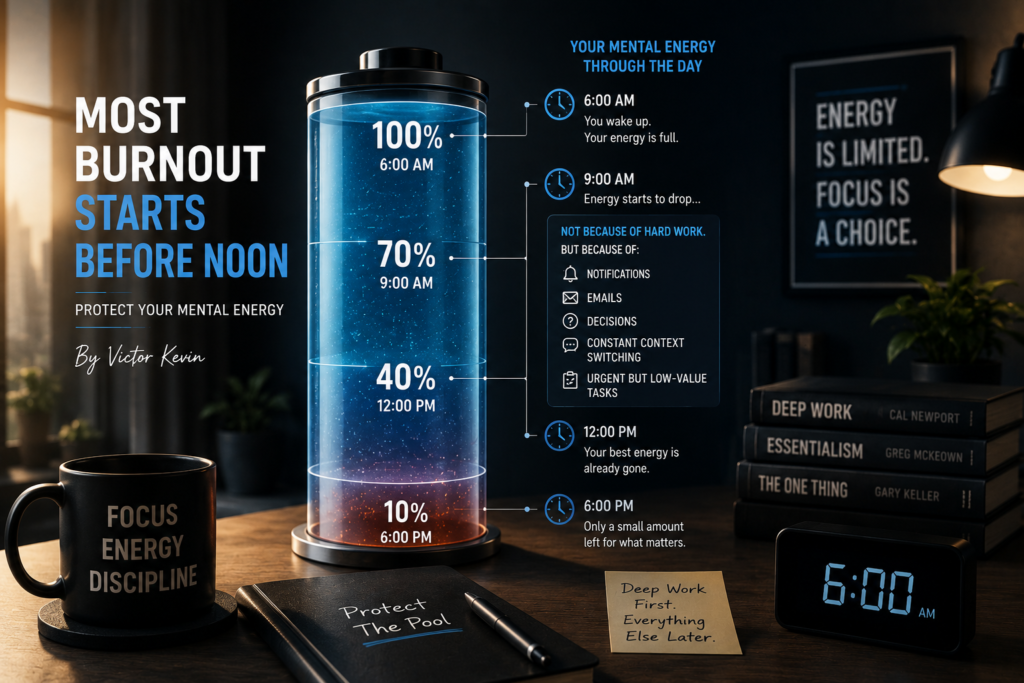
This is the part that confused me longest: I could sleep eight hours and still feel mentally exhausted by noon. Physical rest and mental rest are not the same thing, and conflating them is one of the most expensive mistakes you can make in how you structure your day.
Physical rest restores your body. Your muscles recover, your energy systems replenish. But your brain has its own separate resource pool — one that’s consumed not by physical exertion but by thinking, deciding, processing, and switching between tasks. Every time you make a judgment call, weigh an option, respond to something unexpected, or force yourself to focus against resistance, that pool gets a little smaller.
The problem isn’t that the pool depletes. That’s normal and unavoidable. The problem is when you deplete it before you’ve done your most important work — which is exactly what an unprotected routine does. You wake up, check your phone, respond to messages, make a dozen small decisions before breakfast, scroll, react, plan, respond — and by the time you sit down to do the work that actually matters, the best of your mental energy is already spent.
A daily routine that protects your mental energy isn’t about doing less. It’s about spending the resource in the right order. Deep work first. Low-stakes decisions later. Recovery built into the structure rather than treated as a reward you have to earn.
The morning isn’t just the start of the day. It’s the window when your cognitive resource pool is at its fullest. What you do in that window determines the quality of everything that follows.
2. Early Warning Signs Your Mental Energy Is Running Low
One of the most useful things I did was learn to recognize the depletion before it bottomed out. These are the signs I watch for — in myself, and in the patterns of days that consistently go wrong.
1. Every decision feels heavier than it should. Not just big decisions — small ones. What to eat. Which task to start. How to phrase a sentence. When the easy things feel genuinely hard, the tank is low.
2. You keep reopening the same task without starting. You open the document. Close it. Open it again. This isn’t procrastination — it’s a depleted brain defaulting to avoidance because engagement feels too costly.
3. You’re irritable over things that wouldn’t normally register. Mental fatigue shrinks your tolerance. Traffic, a slow app, a minor inconvenience — things that wouldn’t bother a rested version of you suddenly have weight.
4. You’re reading the same sentence repeatedly. Comprehension degrades before you notice fatigue consciously. If you keep re-reading the same paragraph without retaining it, your brain is telling you something before you hear it.
5. You default to the lowest-effort option every time. Not because it’s the right choice — because it’s the easiest. This is the signature of a depleted decision-making system: it optimizes for effort reduction rather than outcome quality.
6. You feel “busy” all day but produce almost nothing. You were at your desk for eight hours. You answered messages, attended to small things, reacted to whatever appeared. At the end of the day, the important work is untouched. This is mental fatigue masquerading as productivity.
7. Creative thinking disappears entirely. You can follow instructions, respond, execute. But anything requiring original thought — a new angle, a fresh idea, a problem that needs actual thinking — feels genuinely impossible. That’s not a character trait. It’s a depleted resource.
8. You tell yourself you’ll do it tomorrow. Every day. When mental energy is chronically low, tomorrow becomes a permanent holding pattern. Not because you’re lazy — because your brain has learned it never has enough to start.
The moment I recognized these patterns as signals rather than character flaws, everything about how I structure my days changed.
3. Seven Common Daily Routine Mistakes That Accelerate Mental Fatigue
Before I show you what works, it’s worth being direct about what doesn’t — because most of these are invisible until you name them.
Mistake 1: Starting the day with your phone. Within the first minutes of waking, you’ve handed your attention to whatever is most urgent or most engaging in someone else’s world. You’ve begun consuming and reacting before you’ve done a single thing for yourself. The cognitive cost of that re-entry — processing notifications, forming responses, shifting contexts — is front-loaded onto the part of the day when your resource pool is most valuable.
Mistake 2: Doing low-stakes tasks first to “warm up.” Emails, minor admin, quick responses — these feel easy, which is why they’re tempting as a starting point. But they’re still decisions. They still cost something. And they spend your best cognitive hours on your least important work.
Mistake 3: No clear stopping point for deep work. Without a defined end time, deep work bleeds into the rest of the day and you never fully shift down. The brain needs structured transitions — not just hard stops, but rituals that signal the shift between modes.
Mistake 4: Eating without intention. What and when you eat has a direct impact on sustained cognitive energy. A heavy midday meal triggers a physiological response that competes with mental focus. Irregular eating creates blood sugar swings that show up as afternoon crashes. This isn’t about restriction — it’s about timing.
Mistake 5: Taking breaks only when you’re already exhausted. Recovery works best before you need it, not after. Waiting until you’re drained to rest means you’re spending time recovering from a deficit rather than maintaining a level. Scheduled, shorter breaks prevent the crash that longer forced recovery tries to fix.
Mistake 6: Treating all tasks as equally urgent. When everything is a priority, nothing gets protected. The result is a day spent context-switching — jumping between tasks, never completing anything at depth, paying the mental overhead of constant re-entry over and over.
Mistake 7: No evening structure. The evening is not just downtime — it’s preparation for tomorrow’s cognitive quality. A chaotic, stimulating evening leads to lower sleep quality which leads to a smaller resource pool the next morning. What you do in the last two hours of the day directly determines how much you have in the first two hours of the next one.

4. The Complete Daily Routine That Protects Your Mental Energy
This is the actual schedule I run. The times are mine — you’ll need to adjust for your own life. What matters is the structure, the sequence, and the principles behind each block.
4.1 Morning Block — Protect the Pool
5:30 AM — Wake. No phone for 60 minutes. The first hour belongs entirely to me. This is not negotiable. I don’t look at messages, notifications, or anything that requires a response. The brain wakes up slowly — spending those first minutes in reactive mode sets a tone that’s hard to undo for the rest of the day.
5:35 AM — Water and light movement (15 minutes). Not a full workout — just enough to shift the body from sleep state to wakefulness. A short walk, stretching, or bodyweight movement. The goal is circulation and presence, not performance.
5:50 AM — Journaling (10 minutes). Three things: what I’m working on today, what I want to protect, and one thing that’s currently taking up mental space that I can write down and temporarily set aside. This last one is important — externalizing a worry or unresolved problem removes it from active working memory, which is limited and needs to be free for real work.
6:00 AM — Deep work begins. This is the window. Writing, strategy, the most cognitively demanding work I have. No music, no background noise, no task-switching. Minimum 90 minutes without interruption. This block is the reason the entire morning exists.
7:30 AM — First meal. Simple. Nothing that requires decisions. I’ve pre-decided this the night before so there’s no cognitive cost in the morning.
8:00 AM — Second deep work session (60–90 minutes). A second focused block while the pool is still strong. By this point I’ve already done more real work than most people do all day.
4.2 Midday Block — Manage the Transition
9:30–10:00 AM — Communication window. This is when I open messages, respond to emails, handle anything that requires brief reactive work. Contained, time-limited, and positioned after — not before — the deep work is done.
10:00 AM — Movement and genuine rest (30 minutes). Not scrolling. Not passive consumption. A walk, fresh air, or something physical that fully disconnects from screens. This is active recovery — it works differently from sitting on a couch with your phone.
10:30 AM — Lighter work. Administrative tasks, planning, reading, research. Anything that requires engagement but not peak creative output. This is where the day’s logistics live.
12:30 PM — Lunch. Again, pre-decided. Light enough to avoid the afternoon physiological dip that a heavy meal triggers.
4.3 Afternoon Block — Protect What’s Left
1:00 PM — Lowest-effort tasks. By this point in the day, I’m managing a resource that’s been in use for seven hours. I don’t fight this — I work with it. Scheduling, replying to messages, simple organizational tasks, anything that can be done on partial energy without consequences.
2:30 PM — Optional focused work if needed. If there’s something important that didn’t get done in the morning, this is the last window where real focus is possible. I protect this slot by keeping the post-lunch period genuinely low-stakes. If I’ve front-loaded correctly, this slot usually isn’t necessary.
3:30 PM — Walk and intentional break. No screens. This is the buffer between the working day and the wind-down. It prevents the afternoon malaise from bleeding into the evening.
This is also the exact window I described in my piece on decision fatigue after 3PM — where the quality of choices drops and discipline erodes. The walk here isn’t optional. It’s structural maintenance.
4.4 Evening Wind-Down — Prepare Tomorrow’s Pool
5:00 PM — Review and close the day. Five minutes. What did I finish? What carries over? What’s the single most important thing tomorrow needs? Writing this down closes the mental loops that otherwise stay open and consume working memory through the evening.
5:15 PM — Meal and genuine rest. The evening meal and the time after it are non-work. No strategic thinking, no new inputs that need processing. The brain needs several hours of reduced cognitive load before sleep to consolidate the day’s work properly.
7:00 PM — No screens after this (when possible). This is the hardest part of the routine and the one with the highest return. Artificial light and stimulating content — news, social media, anything reactive — push the brain into a state that delays sleep onset and reduces sleep quality. Even an hour of screen-free time before bed measurably improves how you feel the next morning.
8:00 PM — Reading (physical book) or light conversation. Nothing that requires decisions or generates new tasks. This is cognitive cooldown.
9:00 PM — Prepare tomorrow. Lay out what needs to be done. Decide what’s for breakfast. Set out anything I’ll need. This pre-decision work — done when the evening is calm — removes micro-decisions from the morning, which protects the pool from the first minute of the day.
9:30 PM — Sleep. Non-negotiable. The most underrated performance tool there is. Everything in this routine is built around protecting this endpoint.
5. How I Built and Tested This Routine Over 90 Days
I want to be honest about how this actually happened, because it wasn’t a single decision or a clean implementation.
The first version of this routine lasted three days. I tried to change everything at once — the morning, the phone rule, the evening, the meal timing — and by day four I’d abandoned all of it. Not because it was wrong, but because the gap between my existing habits and this structure was too wide to jump in one move.
The second attempt was slower. I started with one change: deep work first, phone after. Just that. For two weeks, nothing else changed. By the end of those two weeks, the morning output had roughly doubled. Not because I was working harder — because I was working at the right time with an uncompromised resource pool.
Then I added the journaling. Then the evening screen limit. Then the pre-decision protocol. Each addition came after the previous one had stabilized — after it had stopped feeling like effort and started feeling like default.
By day 90, the routine wasn’t something I followed. It was simply what my days looked like. The results were specific and measurable in ways I hadn’t expected:
The work that used to take four hours took two. Not because I was rushing — because I was present in a way that I hadn’t been before. Decisions that used to feel heavy in the afternoon stopped requiring effort. The afternoon crash — the one that had been a permanent fixture of my days for months — stopped happening with any regularity.
The most unexpected result was what happened to my evenings. When the mornings were protected and the work was genuinely done by midday, the evenings became actually restful rather than a continuation of a day that never quite ended. That distinction — between real rest and guilty avoidance — changed more than I expected it to.
→ Read: Self Discipline: What I Was Actually Missing — And It Wasn’t Willpower
6. How to Start This Routine in the Next 14 Days
Don’t start everything at once. That’s the mistake I made. Here’s a version that works:
Week 1 — One rule only: deep work first.
Before you check anything — messages, email, social media — do 60 minutes of your most important work. That’s it. Nothing else changes this week. Wake up at whatever time you normally wake up. Eat whatever you normally eat. Just protect the first hour of your working time from reactive input.
By the end of Week 1, you’ll have experienced the difference between a morning that belongs to you and a morning that belongs to everyone else. That experience is more persuasive than any instruction.
Week 2 — Add the evening preparation.
Each evening, write down three things: the most important task tomorrow, what you’ll eat for breakfast, and one thing currently taking up mental space that you can write down and release. This takes five minutes. It front-loads decisions into a low-stakes time slot and clears the morning of the micro-friction that compounds into real cognitive cost.
By the end of Week 2, you have the two highest-leverage elements of this routine in place. Everything else can be added gradually over the weeks that follow — but these two changes alone will produce a visible difference in focus, output, and afternoon energy.
→ Read: How to Start Over: What Nobody Tells You About Rebuilding Yourself From Zero

7. Final Thoughts
Mental energy isn’t infinite and it isn’t fixed. It’s a resource that your daily structure either protects or erodes — and the difference between a day that works and a day that doesn’t is usually structural, not motivational.
You don’t need willpower to protect your mental energy. You need a routine that does the protecting for you. One that front-loads the work that matters, sequences the rest deliberately, and builds in the recovery that prevents the crash rather than treating it after it’s already happened.
The routine I’ve shared here took 90 days to build and several months of failure before that. You don’t have to repeat that process. Start with one week, one change, one morning that belongs entirely to you.
That’s enough to begin.
What’s the one part of your current day that costs you the most mental energy? The answer to that question is where to start.
→ Read: What Is Decision Fatigue — And Why You Make Your Worst Choices After 3PM
→ Read: Discipline When Life Gets Hard: What I Do When Everything Falls Apart
FAQ
What is a daily routine for mental energy? A daily routine for mental energy is a structured sequence of activities designed to protect your cognitive resource pool — ensuring your most demanding work happens when your mental capacity is highest, and that recovery is built into the structure rather than left to chance. It’s the difference between spending your best thinking on what matters most versus depleting it before you begin.
How do I prevent burnout before it starts? Burnout prevention starts with structure, not willpower. The key principles: protect mornings from reactive input, sequence deep work before low-stakes tasks, build genuine recovery into the day rather than waiting until you’re depleted, and create an evening routine that prepares tomorrow rather than extending today.
Why does mental fatigue happen even when I get enough sleep? Because sleep restores physical energy but cognitive resource depletion is driven by decisions, task-switching, and reactive processing — not physical exertion. You can sleep eight hours and still begin depleting your mental energy pool within the first thirty minutes of the day if that time is spent reacting to incoming stimulation.
What is the most important part of a routine to protect mental energy? The morning. Specifically, what you do in the first 60–90 minutes of your working day. That window contains your highest cognitive capacity. How you spend it determines the quality of everything that follows. Protecting it from reactive input — phones, messages, social media — is the single highest-leverage change most people can make.
How long does it take to build a new daily routine? A single habit change stabilizes in roughly two to four weeks. A full routine restructure — multiple changes across morning, midday, and evening — takes longer, typically 60 to 90 days when approached sequentially rather than all at once. The fastest path is one change at a time, held long enough to become automatic before adding the next.
Can this routine work with a full-time job or family commitments? Yes — but it requires adaptation, not adoption. The specific times are mine. The principle is universal: protect your highest-capacity window for your most important work, sequence decisions deliberately, and build recovery in before you need it. What that looks like in your life will be different from what it looks like in mine. The structure matters more than the schedule.
© 2026 SmartXW — Practical Growth, Mindset, Discipline Written by Victor Kevin