
Table of Contents
- The Comfort Zone Feels Like Safety — It Isn’t
- The Hidden Cost of Staying Put
- Why Your Brain Fights You Every Time
- How to Actually Leave — Without Burning Everything Down
- 4.1 Start With Micro-Discomforts
- 4.2 Change the Identity, Not Just the Behavior
- 4.3 Find Your Edge and Stay Near It
- What I Learned Building SmartXW From Zero
- Final Thought
- FAQ
1. The Comfort Zone Feels Like Safety — It Isn’t
I used to think the comfort zone trap was something that happened to other people. The ones who never tried, never risked, never moved. I was moving — building, writing, deciding. But I wasn’t going anywhere, because everything I was doing already felt manageable.
That’s the trap. It doesn’t look like paralysis. It looks like being responsible.
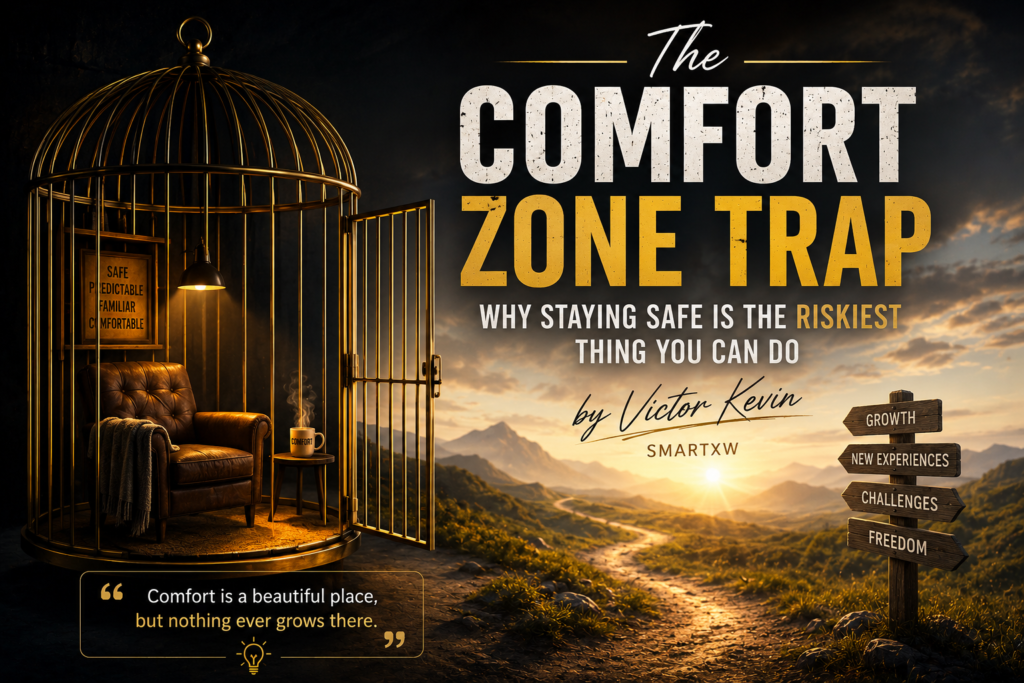
The comfort zone isn’t a place where nothing bad happens. It’s a place where nothing new happens either. And after long enough inside it, the absence of new starts to feel like the absence of risk — which is one of the most expensive mistakes a person can make.
Safety and stagnation feel identical from the inside. That’s what makes this so hard to catch.
2. The Hidden Cost of Staying Put
Here’s what nobody talks about when they tell you to leave your comfort zone: they treat it like a one-time decision. Jump once, land somewhere better, done. But that’s not how it works. The comfort zone isn’t a place you leave. It’s a habit you either keep feeding or slowly starve.
Every time you choose the familiar option — the same routine, the same conversations, the same level of effort — you reinforce the walls. And walls that feel like protection have a way of becoming ceilings without you noticing.
The cost isn’t dramatic. It rarely is. It’s the project you kept delaying. The conversation you avoided for months. The version of yourself you put on hold until conditions improved — and conditions never quite did.
Not because something stopped you. Because nothing forced you. Comfort is the most efficient form of invisible resistance there is.
“The danger isn’t a single missed opportunity. It’s compound stagnation — small avoidances stacking quietly until one day you look up and wonder where the last three years went.”
If you’ve ever rebuilt your life after a period of playing it too safe, you know exactly what this feels like. If you haven’t yet — this is worth understanding before you do.
→ Read: How to Start Over: What Nobody Tells You About Rebuilding Yourself From Zero
3. Why Your Brain Fights You Every Time
The discomfort you feel before doing something new isn’t weakness. It’s wiring.
Your brain processes the unknown the same way it processes threat — with a stress signal that says stop, turn back, stay where it’s safe. That signal was useful once. In a world where the unfamiliar often meant danger, this reflex kept people alive.
But the unfamiliar today isn’t a predator. It’s a new skill. A difficult conversation. A project you don’t feel ready for. The signal fires anyway — because the brain doesn’t distinguish between physical danger and social or professional discomfort. It just flags anything outside the pattern.
This is why willpower alone never works for long. You can’t muscle your way past a biological reflex indefinitely. The reflex always wins if you fight it directly. What actually works is making discomfort so regular that the signal quiets — not because it disappears, but because it stops surprising you.
The goal isn’t to stop feeling uncomfortable. The goal is to keep moving while you feel it.
That’s the difference between people who grow and people who stay exactly where they are, waiting for confidence that was never going to arrive first.
“Your comfort zone isn’t protecting you. It’s just protecting itself.” — Victor Kevin, SmartXW
Most people think they need to feel ready before they act. That’s backwards. Readiness is built by acting. Confidence comes after, not before. The people who look effortlessly bold from the outside aren’t fearless — they’ve simply acted afraid enough times that the fear stopped running the show.
Understanding why your brain resists is also connected to something more specific: the way accumulated small decisions drain your ability to choose clearly later in the day. If you’ve ever noticed your discipline collapsing in the afternoon, this is related.
→ Read: What Is Decision Fatigue — And Why You Make Your Worst Choices After 3PM
4. How to Actually Leave — Without Burning Everything Down
Leaving your comfort zone doesn’t require a dramatic gesture. Quitting your job, moving cities, starting over from scratch — those can be right for some people in some moments. But for most of us, most of the time, the edge is closer than we think and smaller than we expect.
Here’s what actually moves the needle:
4.1 Start With Micro-Discomforts
Not a leap — an inch.
Send the message you’ve been drafting for a week. Speak in the meeting instead of listening from the back. Publish the piece instead of editing it for the third time. Start the thing before you’ve planned it perfectly.
Each small act of discomfort trains the reflex. You’re not changing your life in one move. You’re changing your relationship with discomfort one decision at a time — and that relationship is what determines everything else.
The size of the action matters less than the consistency of it. One uncomfortable choice per day, held over 60 days, produces a different person than a single dramatic leap followed by retreat.
4.2 Change the Identity, Not Just the Behavior
Behavior follows identity. If you see yourself as someone who plays it safe, every action will conform to that story — even when you consciously don’t want it to.
The shift happens when you start deciding who you’re becoming, not just what you’re doing.
“I’m the kind of person who does uncomfortable things regularly” is more powerful than any productivity system. Because systems need willpower to maintain. Identity maintains itself — every action either confirms or contradicts the story you tell yourself about who you are.
Start small. Act like that person once today. Then again tomorrow. The identity solidifies through repetition, not declaration.
4.3 Find Your Edge and Stay Near It
There’s a zone between what’s easy and what’s overwhelming — where the work is genuinely challenging but not crushing. That’s your edge. That’s where growth actually happens.
The goal isn’t to live in panic or chaos. It’s to spend more of your time near the edge than hiding from it. Over time, the edge moves. What once felt terrifying becomes ordinary. Then you find a new edge. And the version of you that exists inside a wider zone is fundamentally different from the one who never left the original one.
A few things worth keeping in mind as you work the edge:
- Discomfort is information, not a stop sign. It tells you where the edge is — not whether to turn back.
- Exposure reduces fear over time. The second attempt is always less terrifying than the first. The tenth barely registers.
- Comfort is earned, not permanent. Rest inside the zone after doing hard things. But let the hard things come first.
- Growth is not linear. Some weeks you expand. Some weeks you consolidate. Both are necessary. Neither is failure.
Much of what makes staying at the edge possible is discipline — specifically, the kind that holds when the motivation is gone. This is something I’ve written about directly, and it connects closely to what we’re talking about here.
→ Read: Self Discipline: What I Was Actually Missing — And It Wasn’t Willpower
5. What I Learned Building SmartXW From Zero

I’m not going to pretend I had this figured out when I started SmartXW.
I had a clear vision for what it could become and a very unclear path to get there. What I had — eventually — was the willingness to do things before I felt ready. To publish before I was confident the work was good enough. To invest time and effort before I could see a return. To keep going on weeks when nothing felt like it was working and the gap between where I was and where I wanted to be looked impossible.
The moments that actually built this — the articles that found real readers, the decisions that compounded into something worth keeping — none of them came from inside my comfort zone. They came from the edges. From decisions I was slightly afraid to make but made anyway.
I spent the first months of building SmartXW doing what felt manageable. It produced manageable results.
The shift came when I stopped asking whether I was ready and started asking whether I was willing. Readiness is a moving target. Willingness is a decision.
“The version of me that started SmartXW made every excuse to stay comfortable. The version writing this sentence learned that the fear doesn’t go away — but it does get smaller every time you refuse to let it decide. That’s not inspiration. That’s just how it actually works.” — Victor Kevin, SmartXW · June 2026
Every time I stayed in the familiar, I felt protected. Every time I pushed past it — even slightly, even imperfectly — something shifted. Not immediately, not dramatically. But over months, those small edges added up to a life that actually looks like the one I was trying to build.
That’s what leaving your comfort zone actually produces. Not a single moment of triumph. A slow accumulation of evidence that you can handle more than you thought. And once you have that evidence, the comfort zone loses its grip — because you’ve seen what’s on the other side often enough to stop believing the inside is the safer bet.

The hardest part of all of this isn’t the action. It’s maintaining it when life gets difficult, when energy is low, and when the results aren’t visible yet. That’s where most people stop — not because they can’t handle the edge, but because they can’t handle it consistently.
→ Read: Discipline When Life Gets Hard: What I Do When Everything Falls Apart
6. Final Thought
Comfort isn’t neutral.
Every day inside the zone without challenging it is a day the zone gets slightly smaller and the world outside it gets slightly larger. The gap between where you are and where you could be doesn’t close on its own. It compounds — in the wrong direction.
You don’t need to be fearless. You don’t need to be ready. You don’t need a perfect plan or a guaranteed outcome.
You need one decision — made today, before you feel like making it — to do something that sits just past the edge of what’s familiar.
That’s it. That’s where the version of you that you actually want to become is already waiting.
FAQ
What is the comfort zone trap? The comfort zone trap is the illusion that staying in familiar, low-risk territory is safe. In reality, avoiding discomfort causes gradual stagnation — you stop growing, stop building new skills, and slowly fall behind while feeling protected. The trap isn’t painful. That’s exactly what makes it dangerous.
Why is leaving your comfort zone so hard? Because your brain processes the unfamiliar the same way it processes physical threat — with a stress signal designed to stop you. Over time, avoidance becomes automatic, not a conscious choice. It feels like self-preservation even when it’s self-limitation.
How do I get out of my comfort zone without feeling overwhelmed? Start with micro-discomforts — small, deliberate actions just outside your current edge. One uncomfortable choice per day, held consistently, rewires your relationship with discomfort more effectively than any single dramatic leap.
Is the comfort zone always a bad thing? No. Rest, recovery, and consolidation happen inside the comfort zone — and they’re necessary. The problem isn’t being there. The problem is never leaving, never testing yourself, and letting comfort harden into a ceiling you eventually mistake for a personality trait.
How long does it take to expand your comfort zone? Consistent small exposures over 30–90 days produce a visible shift in your default response to discomfort. The zone doesn’t disappear — it grows. What once felt overwhelming becomes ordinary, and a new edge appears.
What’s the difference between the growth zone and the panic zone? The growth zone sits between comfort and panic — challenging enough to stretch you, manageable enough to keep going. The panic zone exceeds your current capacity and shuts you down. The goal is to spend more time near your edge and less time hiding from it.
© 2026 SmartXW — Practical Growth, Mindset, Discipline Written by Victor Kevin