
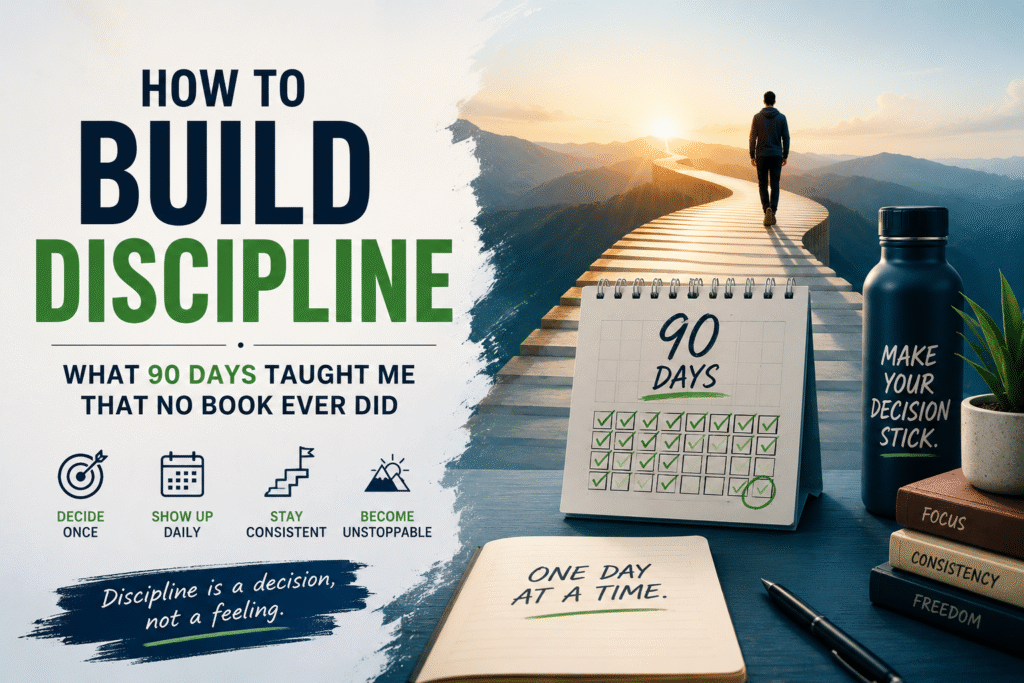
If you’ve been trying to figure out how to build discipline, I want to save you some time: most of what you’ll find online is wrong.
Not wrong in a complicated way. Wrong in the most basic way — it assumes discipline is something you find, like a switch you flip or a mindset you download. It isn’t. I know because I spent three years looking for that switch and never found it.
What I found instead — slowly, uncomfortably, over ninety days — was something nobody put in a framework for me. Something I had to learn by failing at it first.
No productivity hacks here. No morning routine templates. Just what actually happened when I stopped waiting to feel ready and started anyway.
How to Build Discipline When Motivation Keeps Letting You Down
For a long time, I confused the two. When I felt motivated, I called it discipline. When the motivation disappeared — which it always did, usually around day ten — I told myself I lacked discipline. That I wasn’t the kind of person who could follow through.
That story kept me stuck for three years.
The truth I eventually had to face: motivation and discipline are not the same thing, and they don’t work the same way. Motivation is a feeling. Discipline is a decision you’ve already made. You can’t wait for motivation to show up before you start. Discipline means you start regardless of whether it does.
The moment I stopped asking “do I feel like doing this?” and started asking “did I decide to do this?” — everything changed. One question opens a negotiation. The other closes it.
The Day I Realized Motivation Was the Problem, Not the Solution
It was October 2024. I had just finished another failed attempt at building a consistent writing practice — my third in eighteen months. I sat at my desk at 9 AM, the notebook open, the coffee getting cold, and I realized something uncomfortable.
I had been waiting. Every single morning, without noticing it, I had been waiting to feel a certain way before I started. Inspired. Clear-headed. Energized. Ready.
And on the mornings I didn’t feel that way — which was most mornings — I would negotiate. Check my phone first. Just five minutes. Answer one email. I’ll write after lunch. Tomorrow is better anyway.
I had mistaken the feeling of readiness for a requirement. It isn’t. Nobody who has built real discipline waits to feel ready. They start, and readiness — if it comes at all — shows up somewhere in the middle.
Victor’s Note: I wrote this down the morning I figured it out: “Waiting to feel ready is just procrastination with better posture.” I still have that page in my notebook.
Week One: The Discomfort Nobody Warns You About
I started the 90-day experiment on November 1st, 2024. The rule was simple: write for thirty minutes every morning before anything else. No phone. No email. No exceptions.
Week one was harder than I expected — but not in the way I expected.
It wasn’t the waking up early. It wasn’t the writing itself. It was the silence. The absence of input. Every morning I sat down and my brain, accustomed to a constant stream of notifications and feeds and other people’s thoughts, had nothing to grab onto. It felt like standing in an empty room.
By day three, I noticed I was physically uncomfortable sitting with my own thoughts for thirty minutes. That discomfort, I later realized, was the feeling of my attention span trying to remember how to work.
Day 1: 30 minutes. Mostly stared at the page. Wrote two paragraphs. Felt pointless. Day 2: Wrote about how I didn’t know what to write. Still showed up. Day 3: Almost skipped. Picked up my phone before catching myself. Put it down. Wrote. Day 4: Easier than day 3. Not easy — just easier. Day 5: Wrote something I actually wanted to keep. Day 7: First week done. Nothing dramatic. Just done.
Victor’s Note: Day three was the real test. Not day one, when everything feels possible. Day three, when the novelty is gone and the discomfort is real. If you can get through day three, you can get through week one.
The Three Mistakes I Made Before It Clicked
Looking back at my three failed attempts before this one, the mistakes are obvious now. They weren’t obvious then.
Mistake One — I Treated Discipline Like a Feeling Every previous attempt, I waited until I felt disciplined. Which is like waiting until you feel clean before you take a shower. The feeling comes after, not before. I had the sequence backwards.
Mistake Two — I Made the Stakes Too High When I missed a day, I treated it as evidence that I was the kind of person who couldn’t follow through. One missed morning became proof of a character flaw. That story made it impossible to restart.
Mistake Three — I Was Measuring the Wrong Thing I tracked streaks. Days in a row. When the streak broke, the entire project collapsed because the streak was the project. The fourth attempt, I tracked total days — not consecutive days. Missing one reset nothing.
Attempt 1 — January 2023 — 12 days Pure motivation, no structure. Felt like a different person for a week. Then real life arrived and the feeling disappeared with it.
Attempt 2 — July 2023 — 16 days Over-engineered system. One missed morning broke the whole stack. Learned that complexity is fragility.
Attempt 3 — Early 2024 — 22 days Public accountability. Writing for readers, not for myself. When the streak broke, the reason for doing it disappeared too.
Attempt 4 — October 2024 — Still going, 14 months and counting One change. That’s all it took. Not a new system, not a new tool. One decision made once and not revisited daily.

Week Four: The Shift That Changes Everything
Around day twenty-eight, something changed that I hadn’t anticipated.
I stopped thinking about the habit.
Not in a careless way — I still did it every morning. But the mental energy I had been spending on deciding whether to do it, reminding myself to do it, congratulating myself for doing it — that energy mostly disappeared. The morning writing had become background. Part of the day’s shape, like eating breakfast or brushing my teeth.
That’s when I understood what discipline actually is. Not a heroic act of willpower repeated daily. Not a constant battle against a lazier version of yourself. Discipline is what happens when a decision becomes infrastructure — when the choice stops being a choice and becomes simply what you do.
“Real discipline feels boring from the inside. When it’s working, there’s no battle. There’s no victory. There’s just the thing you do, and then the rest of the day.”
Victor’s Note: Someone once told me that real discipline feels boring from the inside. I didn’t understand that until week four. When it’s working, there’s no drama. There’s just Tuesday morning.
What 90 Days of Real Discipline Actually Looks Like
I finished the 90-day experiment on January 29th, 2025. Here’s what actually changed — not what I hoped would change, but what did.
01 — My output tripled Not because I had more time. I had exactly the same hours. But the thirty minutes of focused writing compounded. By month three, I was producing more usable work in that half hour than I had been producing in full afternoons the year before.
02 — My thinking got quieter Removing the morning scroll and replacing it with thirty minutes of writing changed the quality of my thoughts for the entire rest of the day. Less noise. More signal.
03 — I stopped needing motivation to start other things Having one area of my life where I showed up regardless of how I felt seemed to bleed into other areas. I started other difficult things more easily — not because I had more willpower, but because I had daily evidence that I was the kind of person who followed through.
04 — I missed 9 days in 90 Three when I had a fever. Two during a family trip. Four that I simply got wrong. None of those nine days ended the experiment. Because I wasn’t counting a streak — I was building a practice.
05 — Day 90 felt exactly like day 28 Unremarkable. Quiet. Just the thing I do. That’s the point.
The Practical Difference: Before vs After
Before: “I’m trying to build discipline” After: “This is just what I do.”
Before: Decided each morning whether to do it After: Decision made once. Not revisited daily.
Before: Missed one day = broken streak = gave up After: Missed one day = just one day. Back tomorrow.
Before: Performing for an invisible audience After: Doing it because it’s mine. No audience needed.
What This Means If You’re Starting From Zero
I’m not telling you to copy my morning writing practice. The specific habit matters far less than the approach.
If you’ve been trying to figure out how to build discipline and keep running into the same walls — the motivation that fades, the streaks that break — here’s what I’d tell you.
Stop waiting to feel ready. You won’t. Start on a day when you don’t feel like it, because that’s the only way to find out what you’re actually building.
Make missing one day meaningless. Not catastrophic. Not evidence of character. Just one day. Tomorrow is still there.
Measure total days, not consecutive days. Consecutive days makes the streak the goal. Total days makes the practice the goal.
Give it four weeks before you judge it. The first two weeks are the noise. The real signal comes in weeks three and four.

Victor’s Final Note: The most honest thing I can tell you about how to build discipline is this — it doesn’t feel the way you think it will. It doesn’t feel like strength or willpower or victory. It feels like Tuesday morning. Unremarkable. Consistent. Quietly yours. That’s what you’re building toward. Not the dramatic version. The Tuesday morning version.
One Honest Thing to Do Tomorrow Morning
Pick one thing. Not five things — one. Something small enough that missing it would feel like a genuine choice, not an accident.
Do it tomorrow morning before you open your phone.
Don’t track a streak. Just count: day one.
On the day you miss it — and you will miss a day — count it as nothing. Not a failure. Not a reset. Just a gap. The next morning, count: day three.
Keep going until day twenty-eight. Then tell me discipline feels like motivation.
FAQ
How long does it take to build discipline?
Most people notice a real shift around 3–4 weeks, but discipline becomes natural after consistent repetition over months.
Can discipline exist without motivation?
Yes. Motivation starts action. Discipline continues it when motivation disappears.
What is the fastest way to build discipline?
Reduce decision-making. Choose one small action and repeat it daily until it becomes
Victor Kevin is the founder of SmartXW, writing about practical self-improvement, mindset, and discipline. Based in Australia, he documents real experiments in building a more intentional, focused life — one uncomfortable morning at a time.