
If you’ve ever tried to figure out how to build a habit that sticks, you already know the frustrating part: it’s not the first week that breaks you. It’s day nine. Day fourteen, the moment real life shows up and the version of yourself you were trying to become quietly disappears.
I know that feeling better than I’d like to admit.
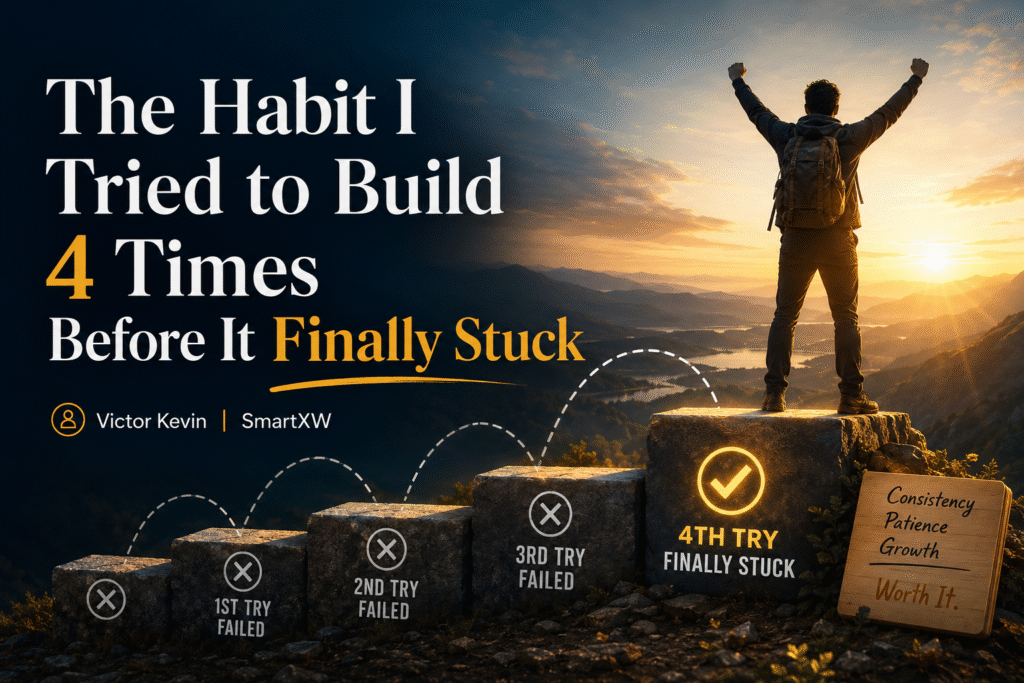
For two years, I tried to build the same habit. Writing every morning thirty minutes, before my phone, before email, before anything else. Just me, a notebook, and whatever was in my head. Simple enough. And yet I failed at it three times before something finally changed on the fourth attempt.
Not because I found a better system, not because I got more disciplined. Because I finally understood what I had been getting wrong the entire time and it had nothing to do with method.
This is that story

How to Build a Habit That Sticks — What I Got Wrong Three Times
The honest answer is that I didn’t fail because of bad timing, or busy weeks, or lack of willpower, i failed because I was approaching the whole thing incorrectly — three times in a row, in three completely different ways.
Here’s exactly what happened each time.
Attempt One: I Was Motivated, Not Committed
The first time I tried to build this habit was January 2023. I had just finished reading a book about morning routines — the kind of book that makes everything sound possible at 11 PM when you’re lying in bed feeling inspired.
I set my alarm for 6 AM. The first morning, I was up before it went off. I made coffee, sat at my desk, opened my notebook, and wrote for forty minutes. It felt great. I felt like a different person.
By day four, the alarm felt like an accusation. By day nine, I started negotiating with myself. I’ll do it tonight instead. I’ll do it tomorrow morning. I did it yesterday so I can skip today. By day twelve, I had stopped entirely and convinced myself I was just “not a morning person.”
Victor’s Note
What I know now: I was running entirely on motivation — the emotional high from the book, the novelty of the first few days. Motivation is real and useful. But it has a half-life of about a week. After that, it needs to be replaced by something structural. I had no structure. Just feeling.
Attempt Two: I Made It Too Complicated
Six months later, in July 2023, I tried again. This time I came prepared. I had a habit tracker app. I had a specific journal with prompts. I had a “morning routine stack” that included the writing, plus five minutes of meditation, plus reading one page of something non-digital.
I lasted sixteen days. The system collapsed the first time I had an early meeting. I missed one morning, and because I had built this elaborate routine where everything was connected, missing one piece felt like failing the whole thing. So I stopped the whole thing.
“I had confused complexity with commitment. A system with seven moving parts isn’t more disciplined than a simple one. It’s just more fragile.”
Looking back, I was using the planning and the tools as a way to feel productive without doing the actual hard thing — which was just sitting down and writing when I didn’t feel like it.
Attempt Three: I Was Performing for an Audience That Didn’t Exist
By early 2024, I was building SmartXW. I had started writing publicly about discipline and habits. So naturally, I tried again — this time with extra motivation: accountability. I mentioned on the site that I was committing to a daily morning writing practice.
Twenty-two days. My longest streak. Then I got sick for four days, missed the practice, and when I felt better, I couldn’t restart. The public commitment had actually made it worse. I had been writing every morning partly to prove something to readers, not because I valued the practice itself. When the streak broke, the motivation evaporated instantly because it was never really mine.
1
Attempt 1 — January 2023
Lasted 12 days
Pure motivation, no structure. Felt like a different person for a week. Then real life arrived and the feeling disappeared with it.
2
Attempt 2 — July 2023
Lasted 16 days
Over-engineered system. One missed morning broke the whole stack. Learned that complexity is fragility.
3
Attempt 3 — Early 2024
Lasted 22 days
Public accountability. Writing for readers, not for myself. When the streak broke, the reason for doing it disappeared too.
4
Attempt 4 — October 2024
Still going — 14 months and counting
One change. That’s all it took. Not a new system, not a new tool. One honest shift in how I thought about what I was doing.
What Finally Worked — And Why It’s Uncomfortable to Admit
In October 2024, I tried for the fourth time. I didn’t buy a new journal. I didn’t download an app. I didn’t tell anyone.
The only thing I changed was this: I stopped treating the habit as something I was building and started treating it as something I already was.
That sounds abstract. Here’s what it meant in practice. Every previous attempt, I framed the morning writing as a goal — something I was working toward. I’m trying to become someone who writes every morning. Which meant every morning I woke up, I had to make a decision: am I going to do this today?
In October 2024, I changed the frame. I decided: I am someone who writes every morning. Not trying to be. Already am. The decision had been made. It wasn’t up for renegotiation each day.

This removed the daily negotiation entirely. I didn’t wake up and ask myself if I felt like writing. I woke up and wrote, the same way I brush my teeth — not because I’m motivated, not because I’m tracking a streak, but because it’s just what I do.
“The habit didn’t stick because I found a better system. It stuck because I stopped treating it as optional.”
The Practical Difference
What Changed Between Failure and Success
Before ✗
“I’m trying to build a writing habit”
After ✓
“I write every morning. That’s just who I am.”
Before ✗
Decided each morning whether to do it
After ✓
Decision made once. Not revisited daily.
Before ✗
Missed one day = broken streak = gave up
After ✓
Missed one day = just one day. Back tomorrow.
Before ✗
Writing to prove something — to myself or others
After ✓
Writing because it’s part of what I do. No audience needed.
I’ve now been writing every morning for fourteen months. I’ve missed eleven days total — three when I had a fever, two during a family emergency, six during a trip where the logistics made it genuinely impossible.
None of those gaps ended the habit. Because I wasn’t maintaining a streak. I was just being myself. And yourself doesn’t disappear because you had a difficult week.
What This Means For Your Habit
I’m not telling you to copy my morning writing practice. The habit doesn’t matter — the framework does.
If you’ve tried to build a habit more than twice and it keeps failing, the problem is almost certainly not willpower, motivation, or the right system. The problem is that you’re still treating the habit as something external — a goal to reach, a behavior to perform — rather than part of who you are.
The shift is simple to describe and genuinely difficult to make: stop asking will I do this today and start assuming this is what I do.
It won’t feel true at first. That’s fine. Identity doesn’t form in a day. But it forms faster than you think when you stop leaving the door open for negotiation.
Victor’s Final Note
The most honest thing I can say about this: I spent two years looking for the right method. The right journal, the right time, the right accountability structure. None of it worked because the problem was never the method. It was that I kept treating the habit as something I was doing, not something I was being. The fourth attempt worked not because I got smarter, but because I finally got honest about what was actually holding it back.
One Thing to Try This Week
Pick one habit you’ve tried and failed to build before. Not a new one — one you already know you want.
Write this sentence about it: “I am someone who [habit]. That’s just what I do.”
Then do it tomorrow morning as if the sentence is already true. Not to prove it. Not to start a streak. Just because it’s what you do now.
See what’s different on day eight.
Watch — Recommended Video
Victor Kevin is the founder of SmartXW, writing about practical self-improvement, mindset, and discipline. Based in Australia, he documents real experiments in building a more intentional, focused life.