

It’s not that you don’t want to change. It’s not that you don’t know what to do, if you keep asking yourself **why you can’t start, after six months of “preparing” to launch SmartXW while writing nothing, I finally understood what was actually in the way, and how to permanently remove it.
If you’ve ever wondered why you can’t start something you genuinely want to do, the night before I launched SmartXW might sound familiar. I reorganized my desktop for the third time, re-read four articles I had already read twice, made coffee I didn’t drink, and went to bed having written exactly nothing. I told myself I wasn’t ready, what I didn’t know yet was that “not ready” was never the problem.
If you’ve been circling something for weeks, or months, or longer, and you can feel the gap between your intention and your action growing wider every day, this isn’t about willpower. It isn’t about discipline. And it definitely isn’t about laziness.
I know this because I’ve been there, and I’ve spent the years since building SmartXW trying to understand exactly what “there” is why intelligent and motivated people end up frozen in place, and how to actually move.
Table of Contents
- Why calling it laziness is the wrong diagnosis
- The thing I was actually protecting
- The three invisible traps keeping you stuck
- What finally broke the cycle
- Stuck vs. Moving — the real difference
- The four steps I use every time I get stuck
- The question worth sitting with
Why Calling It Laziness Is the Wrong Diagnosis

Laziness is a useful word because it ends the conversation. You say “I’m lazy” and the explanation feels complete. But I’ve never met a genuinely lazy person who was also deeply frustrated by their own inaction. Lazy people aren’t tormented by their not-starting. They’re comfortable with it.
The people who can’t start — myself included, for a long stretch — are not comfortable. They think about the thing constantly. They plan it, research it, imagine it. They want to do it. They just can’t seem to begin.
That is not laziness. Calling it laziness doesn’t just fail to solve it — it actively makes it worse. It suggests the solution is to try harder, care more. But you already care. That’s exactly why it’s painful.
“The more something matters to you, the harder it often is to start. The projects easiest to begin are the ones you care about least.”
The Thing I Was Actually Protecting
In late 2023, I had been “planning” SmartXW for six months. I had content strategy documents, category structures, keyword research, visual identity concepts. I had everything a serious person preparing a serious project would have.
I had everything except a single published word.
One October night I wrote this in my journal:
“Honest question: what exactly am I waiting for? I’ve researched this. I’ve planned it. I know what I want to say. Every time I open the document, something pulls me back to another round of preparation. I think I finally understand what’s happening. As long as I haven’t started, the perfect version is still possible. The moment I start, it isn’t. I’ve been protecting the potential — not building the thing.”
That was the first time I named it accurately. I wasn’t afraid of failure in the conventional sense. I was afraid of the gap — between the version of SmartXW I could see in my head, polished and exactly right, and the messy imperfect version that would exist the moment I typed the first sentence.
Not starting kept the idealized version alive. Starting would replace it with something real. And real things have flaws.
“Not starting isn’t the opposite of failing. It is failing — just the version that’s quiet enough to live with indefinitely.”
The Three Invisible Traps Keeping You Stuck
Almost everyone who can’t start is caught in one — or all three — of these patterns. I lived inside each of them longer than I’d like to admit.
Trap 1 — The Research Trap
There is always one more article to read. One more framework to understand. One more perspective to consider before you’re finally ready. Research feels like work — and it is, up to a point. But if you’ve been researching the same topic for more than two weeks and you’re still adding to the pile rather than doing anything with it, you’re not building a foundation anymore. You’re building a reason to wait.
I eventually set a hard rule: a fixed research window. When it ends, the work begins — whether I feel ready or not. The feeling of readiness doesn’t come from more information. It comes from starting.
Trap 2 — The Perfect Plan Trap
I filled three notebooks planning SmartXW before I published anything. The plans were useful — eventually. But as a substitute for starting, they were enormously expensive. Every hour spent planning instead of doing is an hour of real information you don’t have. A plan is a hypothesis about what will work. The only thing that proves or disproves the hypothesis is contact with reality.
I wasn’t planning. I was delaying contact with reality behind the cover of productivity.
Trap 3 — The Right Time Trap
Byron Bay has seasons. The ocean doesn’t ask whether conditions are perfect before it moves — it moves because it moves. I spent years waiting for an uninterrupted stretch of time, the right mental state, the right level of energy and clarity.
The right time is not a feeling. It’s a decision. I’ve never once begun something important and thought “yes, this was the perfect moment.” Those moments were always manufactured — carved out deliberately, imperfect, slightly inconvenient. Not found. Made.
What Finally Broke the Cycle
I separated the draft from the standard
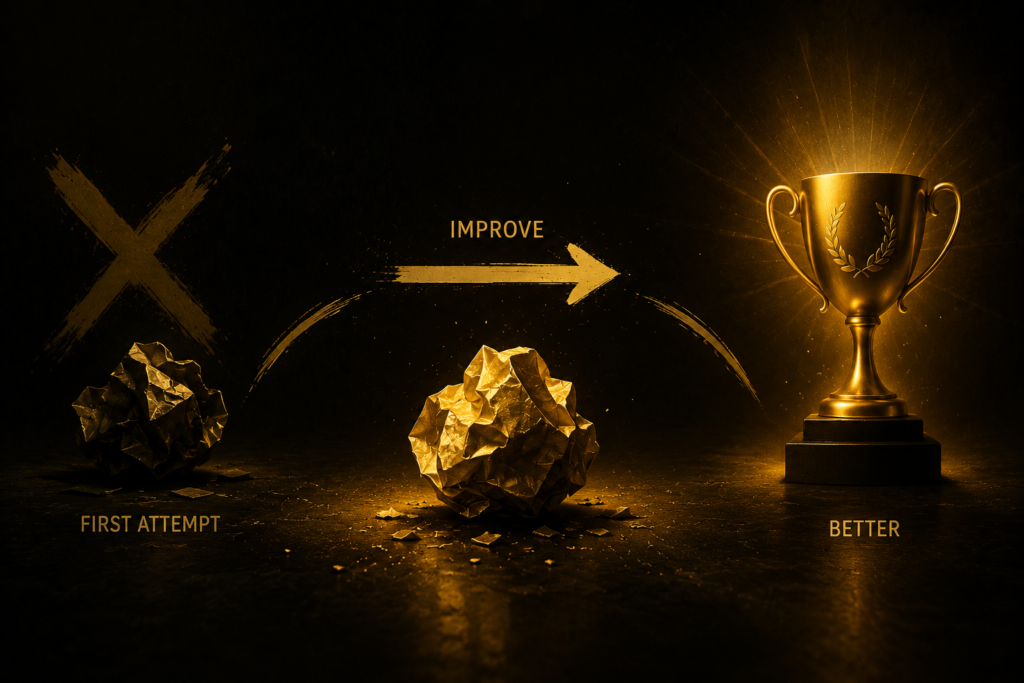
The core of my paralysis was holding the first draft to the same standard as the published version — before a single word existed. Once I genuinely accepted that the first draft exists only to be raw material, starting became a completely different act. I wasn’t producing something good. I was producing something to work on.
I made the start smaller than felt reasonable
I changed the definition of “starting.” Starting meant opening the document and writing one sentence. Any sentence. Even a wrong one. The only rule: more words at the end than at the beginning. Even one word more counted.
The first sentence I ever wrote for SmartXW was: “I don’t know how to begin this.” That sentence is not in any published article. But it produced the second sentence. The second sentence produced the third. The first published article on this site exists because of a sentence nobody has ever read.
I stopped trying to feel ready first
I have never once felt completely ready before beginning anything that mattered. The feeling of readiness came during the work — not before it. I had the order wrong for years. I was waiting for readiness to enable starting. Starting was what created the readiness.
Stuck vs. Moving — The Real Difference
| ❌ What Keeps You Stuck | ✅ What Actually Moves You Forward |
|---|---|
| Waiting until you feel ready | Deciding to start at a specific time regardless of feeling |
| Holding the first attempt to a final standard | Making the goal explicitly “produce something to improve” |
| Starting with the hardest part | Starting with the easiest part — any part — to break inertia |
| Needing a large block of uninterrupted time | Twenty minutes with one small, specific deliverable |
| Researching until certainty arrives | Acting until clarity arrives |
The Four Steps I Use Every Time I Get Stuck
Step 1 — Name it accurately. Say out loud which trap you’re in: “I’m in the research trap” or “I’m protecting the potential.” Naming it reduces its power significantly.
Step 2 — Define the smallest possible start. Not “write the article.” Not “work on the project.” Write the opening sentence. Send one email. Fill one paragraph. One concrete, small thing.
Step 3 — Set a timer for twenty minutes. Commit only to that. Not to finishing. Not to producing something good. Just to twenty minutes of contact with the work.
Step 4 — Do it badly on purpose. Treat imperfection as the goal of the first session, not a side effect to be managed. This removes the psychological weight almost completely.
Key Takeaways
Inability to start is not laziness — it’s usually the sign of something that matters deeply to you.
We protect the “perfect potential” of an unstarted project more than we want to admit — and understanding this is the first real step.
Research, perfect planning, and waiting for the right time are the three most common forms of productive-feeling avoidance.
The feeling of readiness comes from starting — not before it. The order matters enormously.
Making the first step deliberately small and deliberately imperfect removes the psychological barrier almost completely.
Clarity is generated by action — preparation can only simulate it.
The Question Worth Sitting With
Think about the thing you’ve been circling. The project, the change, the start you keep preparing for. Ask yourself honestly:
If you knew with certainty that the first version would be imperfect — that it would fall short of what you imagine — would that give you permission to begin?
If yes, you already know what’s in the way. It’s not time, not knowledge, not circumstances. It’s the belief that imperfect output says something permanent about you. It doesn’t.
An imperfect first draft is not evidence of your limitations. It’s the only material from which something better can be built.
Start Before You’re Ready
The first version of SmartXW looked nothing like what it is now. The first article I published had errors I still notice. Every single one of those imperfect starts was more valuable than another month of preparation would have been.
Because imperfect action is the only mechanism that generates the information you actually need. Not the information you think you need — the information that reality gives back when you finally make contact with it. Planning can simulate that feedback. Only doing produces the real thing.
You don’t need to be ready. You need to be willing to be imperfect temporarily — and trust that everyone who has ever built anything real started exactly there.
— Victor Kevin, Byron Bay
Frequently Asked Questions
Frequently Asked Questions
Q: Is not being able to start a sign of laziness?
No. Laziness is comfort with inaction. If you’re frustrated, planning constantly, and thinking about the thing you can’t start — that’s not laziness. That’s something completely different, and it needs a different solution.
Q: How long is too long to spend in the “preparation” phase?
A practical rule I use: if you’ve been preparing for more than two weeks without producing anything, preparation has become avoidance.
Set a hard deadline — research ends on a specific date, and work begins the next day regardless of how ready you feel.
Q: What if my first attempt really is terrible?
That’s exactly the goal.
A terrible first attempt gives you something real to improve. A perfect plan that never becomes anything gives you nothing.
Every good piece of work on SmartXW started as something I’m glad nobody saw.
Q: What’s the difference between this and procrastination?
Procrastination is avoiding something you don’t want to do.
What this article describes is being unable to start something you genuinely want to do. The cause is different, which means the solution is different.
I covered procrastination specifically in How to Stop Procrastination.
Q: How small should the “first step” actually be?
Smaller than feels reasonable.
If your goal is to write an article, the first step is one sentence — not one paragraph, not one section. One sentence.
The bar needs to be low enough that even on your worst day, you can clear it.
Q: Does this approach work for big life changes, not just projects?
Yes — and in my experience it works even better there.
The bigger the change, the more the brain resists starting. Breaking it into the smallest possible first action removes almost all of that resistance.
One conversation. One phone call. One paragraph. Start there.