
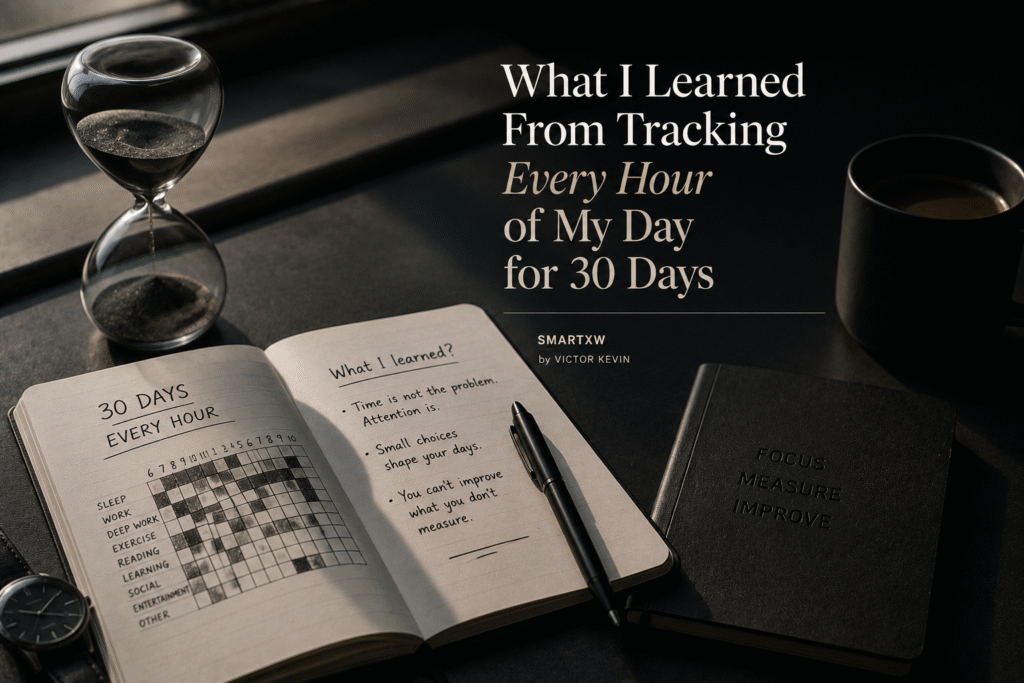
I thought I knew where my time went. The data said otherwise. Here’s what 30 days of honest tracking revealed — and what I changed because of it.
I was lying to myself about my time
I used to tell people I worked hard. Six, seven, sometimes eight hours a day on my goals. Building the website, writing, planning, creating. I believed it, too. It felt true.
Then I started tracking.
On day three of the experiment, I looked at my log and found something uncomfortable: I had spent just over two hours on actual, focused work. The rest of the day had disappeared into emails I didn’t need to send, YouTube videos I barely remembered watching, and long gaps I couldn’t even account for.
I’d been confusing being at my desk with being productive. They are not the same thing.
“I thought I was putting in the hours. My notebook told a different story. Six hours at the desk, two hours of real work. That’s the gap nobody talks about.”
This is what made me commit to the full 30 days. Not to optimize my life into a machine, but to get honest data on where my time actually went — and finally do something about it.

A simple notebook was all I used — no fancy apps required.
How I did it — the simple method
I didn’t use a complicated app or color-coded spreadsheet. I bought a small notebook and kept it on my desk. Every hour, I wrote one line: what I had been doing for the last 60 minutes. That’s it.
No judgment. No categories at first. Just honest, one-line entries.
- 8:00 AM — Made coffee, checked phone, read three articles I didn’t finish
- 9:00 AM — Sat at desk, opened laptop, replied to two emails, got distracted
- 10:00 AM — Wrote 400 words for the blog
- 11:00 AM — YouTube. Told myself it was “research”
After the first week, I grouped the entries into four categories: Deep Work, Admin/Email, Distractions, and Rest. Then I added up the totals. The numbers were not what I expected.
The data from week one — honest and uncomfortable
2.1hAvg. deep work per day
1.4hAvg. lost to distractions
47minAvg. email and admin
3.2hUnaccounted time per day
That last number hit me hardest. Over three hours a day that simply vanished — not rest, not work, not anything intentional. Just gone. Transitions between tasks, phone in hand without purpose, sitting somewhere between focused and distracted.
By the end of week one, I had a clear picture I hadn’t wanted to see: I was getting maybe 10–12 hours of real, useful work done per week. Not per day. Per week. I had been telling myself — and anyone who’d listen — that I was putting in serious hours.
The real insight wasn’t that I was lazy. It was that I had zero awareness of where my time was going. I couldn’t fix something I wasn’t measuring.
What changed in weeks two and three
Something interesting happened around day 10. Just the act of writing things down started changing my behavior. Not because I forced myself to change — but because I was watching myself, and I didn’t like what I saw.
It’s the same reason people lose weight when they start tracking calories. You don’t have to try harder. Awareness alone does a lot of the work.

By week two, the notebook became a daily anchor — something I actually looked forward to.
I noticed three specific patterns in my data:
Pattern 1: My mornings were being wasted
Every day, the first hour after waking up was almost completely unproductive. Phone in bed, slow coffee, drifting through Instagram. By the time I sat down to work, my brain had already been pulled in five directions. This wasn’t a motivation problem. It was a morning structure problem.
I changed one thing: no phone for the first 45 minutes of the day. Just coffee and opening my work document. Within a week, my morning deep work sessions doubled.
Pattern 2: I was most focused between 9 and 11 AM
The data was consistent across all 30 days. My best, most focused work happened in a two-hour window in the morning. After noon, my output dropped noticeably — longer sessions, fewer words, more mistakes, more distraction.
I stopped fighting this. Instead of trying to work for eight hours straight, I protected that morning window obsessively and used the afternoons for lower-energy tasks: admin, planning, reading.
Pattern 3: “Short breaks” weren’t short
I’d take a break, pick up my phone to check something quickly, and look up 35 minutes later. This happened more times than I want to admit. The data made it impossible to ignore. What I thought were 5-minute breaks were averaging 25–40 minutes — and they completely killed my momentum every time.
The video that helped me understand why this works
Halfway through my 30 days, I found a video by Matt D’Avella on exactly this experiment. He did something similar — tracking every hour of his time for a month — and came to similar conclusions. Watching it felt like someone had filmed my experience before I had it.
I recommend watching it if you’re thinking about starting your own version of this experiment:
“I timed everything for 30 days” — Matt D’Avella
Week four — the results after adjusting
By the final week, I had made three small but specific changes based on what the data showed me:
1
No phone for the first 45 minutes of the day
Simple. Hard the first few days. Then automatic. This single change gave me back almost an hour of quality work time every morning that I was previously wasting on nothing.
2
Protected the 9–11 AM block as non-negotiable deep work
No calls, no emails, no admin during these two hours. Just the most important work of the day. Everything else moved to afternoon. My weekly output nearly doubled in the last two weeks just from this one schedule shift.
3
Replaced phone breaks with timed breaks
If I needed a break, I set a timer for 10 minutes. Walk around, make water, stare out the window — but no phone, no YouTube. When the timer went off, I came back. This sounds small. The impact on afternoon productivity was significant.
Here’s how the numbers compared between week one and week four:
| Category | Week 1 (daily avg) | Week 4 (daily avg) | Change |
|---|---|---|---|
| Deep work | 2.1 hours | 3.8 hours | +81% |
| Distractions | 1.4 hours | 0.5 hours | -64% |
| Unaccounted time | 3.2 hours | 1.1 hours | -66% |
| Admin/email | 47 min | 38 min | -19% |
I didn’t work more hours. I didn’t push myself harder. I just stopped wasting the hours I already had.
What surprised me most about the whole experiment
I expected the data to show me I was distracted too much. I knew that going in. What I didn’t expect was how much the act of tracking itself would change things.
By week two, I was catching myself reaching for my phone and stopping — not because I had more willpower, but because I knew I’d have to write it down. Having a record of your behavior makes you more honest with yourself. There’s nowhere to hide when you’re the one keeping the score.
The second surprise was how small the fixes needed to be. I didn’t overhaul my entire life. I changed three things, two of which took less than a minute to implement. Most productivity problems don’t need a new system. They need a mirror.
“Most productivity problems don’t need a new system. They need a mirror. Tracking gave me mine.”
Should you try this? Here’s how to start

You don’t need a perfect system to start. A notebook and consistency is enough.
You don’t need a special app or a perfect system. Here’s the simplest version of what I did:
- Get a small notebook and keep it on your desk
- Every hour, write one sentence: what you were actually doing
- At the end of each day, add up the categories: work, admin, distraction, rest, unaccounted
- After one week, look for the patterns — not to judge yourself, but to see clearly
- Pick one thing to change. Just one. Do it for a week and measure again
Most people skip this because they’re afraid of what they’ll find. I understand that. But the discomfort of seeing the truth for a few days is nothing compared to spending months or years wondering why you’re not making progress.
You already have the hours. You just need to see where they’re going.
Final thoughts
Thirty days of tracking didn’t turn me into a productivity machine. It didn’t add hours to my day or make me suddenly disciplined. What it did was give me data I couldn’t argue with — and once you see clearly, it becomes much harder to keep fooling yourself.
I went from 2.1 hours of real focused work per day to 3.8 hours — not by trying harder, but by eliminating the gaps I didn’t even know existed.
You don’t have a time problem. You have a visibility problem. Track your hours for one week and you’ll know exactly what to fix. The answers are already in your day — you just haven’t looked closely enough yet.
Victor Kevin is the founder of Smartxw, a platform focused on practical self-improvement, mindset, and discipline. He writes about building better habits, stronger thinking, and a more intentional life.